




“BPA-free” is printed on an enormous share of kitchen gadgets, and it is one of the least informative statements in the housewares aisle. It is also one of the first things a retail compliance team asks about, a common source of marketplace listing takedowns, and the claim most likely to be tested by a journalist or a regulator rather than by a customer. For a buyer putting together a kitchen gadget programme, the practical goal is a claim whose scope matches the product and whose supporting evidence is tied to the destination market and the actual materials used.
Build the evidence file around the product as made: identify relevant components, material grades, intended food-contact conditions and the SKUs covered by each report. A colour or supplier change may affect the evidence scope, so review the formulation and test plan when the product changes. Do not assume that every colourway always needs a separate certificate or that a supplier’s general accreditation covers the finished article.
What “BPA-Free” Actually Claims
Bisphenol A (BPA) has been used in some polycarbonate and epoxy food-contact applications. A “BPA-free” statement should identify what parts of the product it covers and how the claim is substantiated; the wording alone does not establish food-contact compliance or prove zero migration. The FDA describes BPA’s use in specific food-contact applications and its actions on certain uses.
Do not infer BPA presence or absence from a part’s appearance or from a broad polymer-family name. Ask the supplier to identify the actual resin grade, additives, coatings and other relevant components, then define which parts the claim covers and what evidence supports it. A claim about the whole gadget needs evidence for the whole scope; a claim about one component should say so clearly.
If the marketing claim is intended to cover the whole article, its evidence should address the complete claim scope, including relevant inserts, gaskets, coatings and bonded components. State the analytical method, detection or reporting limits and parts tested where those details are material to the claim.
Food-Contact Rules by Destination Market
Food-contact requirements depend on the destination market, intended use and substances in the article. A generic “food-contact certified” statement is not enough to show compliance everywhere. In the U.S., the FDA describes the applicable routes for each relevant substance; the EU uses its own framework and specific measures, summarized by the European Commission. Ask for records that identify the market, product and conditions covered.
- United States – compliance is established through the food-contact substance regulations, typically evidenced by supplier compliance letters supported by testing, and Washington State adds its own restrictions on certain substances in specific product groups.
- European Union – a framework regulation sets the general duty that materials do not transfer constituents to food in quantities that endanger health, with plastics subject to an overall migration limit and substance-specific limits backed by a documented declaration of compliance.
- Germany – its food and feed code is stricter in reputation and in some of its limits, which is why European buyers recognising that mark often treat it as a quality signal above the baseline.
- United Kingdom – now runs its own retained regime post-Brexit, so UK-bound shipments need their own documentation rather than relying on an EU dossier.
- China, Japan and others – each maintains its own positive lists and testing protocols; where a programme ships into them, name them explicitly rather than assuming a US or EU report suffices.
For a buyer, the practical instruction is simple: name the destination countries in the order, require reports against each one’s applicable framework, and make those reports a release condition rather than a post-shipment document chase.

How Migration Testing Produces a Certificate
Both frameworks rest on the same physical idea – exposing the material to a food simulant under controlled time and temperature, then measuring what came out. Overall migration limits the total transfer. Specific migration limits individual substances of concern, including monomers, additives and, where relevant, metals from any metal contact.
Three variables define whether a report means anything, and they are all written into the report header:
- Simulant and conditions – acidic, fatty and alcoholic foods extract differently, and the simulant plus temperature plus duration must match how the gadget is actually used.
- Contact time and temperature – a peeler in cold brief contact is not the same test as a ladle resting in a hot pot for an hour. A report run at the wrong conditions is a report about a different product.
- The article versus the material – the strongest document is a test conducted on the finished article or a section of it, because processing history changes migration behaviour. A generic pellet-level certificate is weaker and should be treated as supporting evidence only.
Colourways, Components and the Certificate File
Pigments, masterbatch carriers and coatings can change a formulation. Compare the shipped SKU with the materials and colour variants covered by the existing assessment; commission additional testing or documentation when the change affects regulatory coverage or the test plan. A separate certificate for every colourway is not a universal requirement, so document the reason for the scope chosen.
Map the parts that contact food and the substances that may migrate under the intended conditions. For a multi-material article, identify the overmould, shaft, print or bonded decoration in the assessment and confirm whether each is relevant under the applicable market rules; the required evidence depends on the material, use and authorization route.
Ask for the file to be organised by finished SKU, so the documents map onto what is actually on the pallet:
- Per SKU: declaration of compliance, named to the destination market.
- Per material and colourway: third-party test reports with report numbers and laboratory names.
- Per shipment: batch traceability linking the moulded parts back to the tested lot.

Marking, Label Claims and Batch Traceability
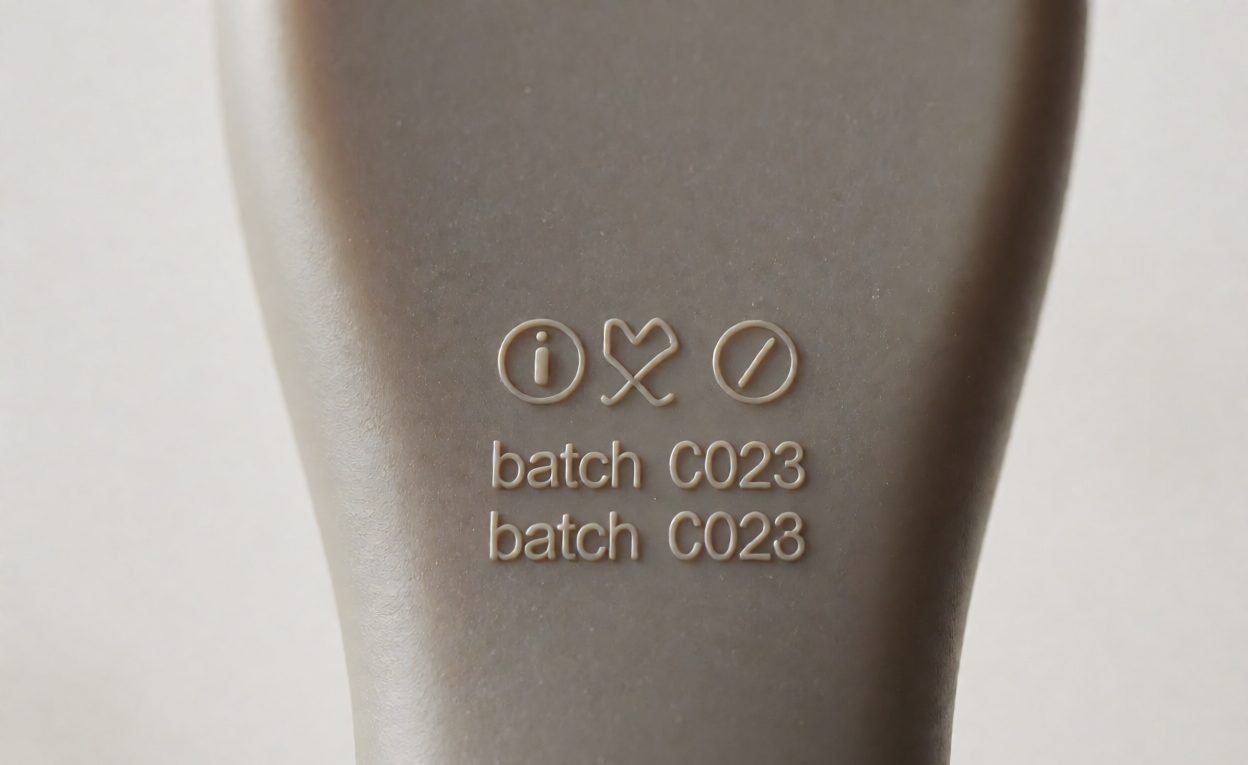
As a buyer control, link each SKU and production lot to its material declarations, supplier, test reports and approved artwork. Marking and food-use labeling requirements vary by market and product, so confirm the applicable rules before artwork approval rather than assuming that every article needs the same resin mark or date code.
Two claims deserve particular care in copy. Temperature claims on the packaging – dishwasher safe, boiling water safe – must be supported on the finished article, including any decoration, because the decorated part usually fails before the body does. And false reassurance is a risk in the other direction: advertising an absence the categories never contained reads as marketing spin to an informed retail buyer, while inviting scrutiny of whatever was not tested.
Technical Background
BPA has been used in some polycarbonate and epoxy applications, but appearance alone does not establish a part’s composition. Food-contact rules and evidence differ by market: see the FDA’s BPA overview and the European Commission’s food-contact legislation summary. Migration testing may be part of the evidence where required for the material and intended use; it is not a single universal certification method.
Related Decisions in the Kitchen Gadget Brief
Certification follows material choice, so specify the two together – the head and body material trade-offs are treated in the nylon versus silicone head comparison and the set material and heat resistance specification, while polymer families generally are compared in the ABS, PP and PC guide. Composition of any soft grip or hybrid handle is discussed in the handle grip and ergonomics specification, the children’s tableware analogue of the same documentation problem in the FDA and LFGB tableware sourcing guide, and the parallel evidence discipline for seals in the lid seal and leak test specification. For how documents fit a broader inspection plan, see the AQL inspection guide.
Frequently Asked Questions
Does BPA-free on the box prove anything?
A material declaration helps define the claim, but it is not food-contact approval by itself. Tie the claim to the relevant product parts and support it with evidence appropriate to the destination market, material and intended use.
Can one EU report cover the whole programme?
No. Requirements differ by destination market, so name each country and require reports against its framework.
Does every colourway need its own test?
Yes. Colourants and carriers change the formulation, and a report on the natural version does not cover the coloured SKU.
What is the difference between overall and specific migration?
Overall limits total transfer into the simulant; specific limits individual substances of concern such as residual monomers or additives.
Is a pellet-level material certificate enough?
It is supporting evidence only. Testing on the finished article is stronger because processing history affects migration.
Which part fails the temperature claims first?
Almost always decoration or a second component rather than the body, so test the finished, decorated article through repeated cycles.
What should I require for traceability?
Material marking and a batch or date code per article, plus documents filed by finished SKU so any later question resolves to one lot.