




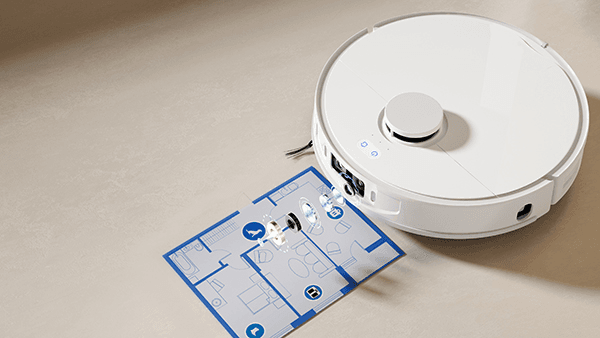
As smart homes become more widespread, robotic vacuum cleaners are gradually becoming essential household cleaning assistants. To design an effective robotic vacuum solution, a solution provider must take multiple factors into account.
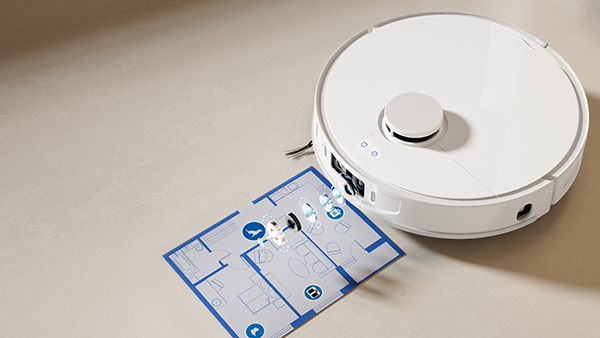
Navigation and Positioning Technology
First, navigation and positioning technology are central to robotic vacuum cleaners. Combining LiDAR (Laser Radar) with visual sensors allows for accurate indoor mapping and real-time positioning. This enables the robot to efficiently plan cleaning paths, avoiding repeated or missed areas. Advanced algorithms further enhance navigation by allowing the robot to adapt to changes in the environment, such as furniture rearrangement or obstacles that may not have been present during the initial mapping.
Cleaning System Design
Second, the design of the cleaning system is crucial. A robotic vacuum should be equipped with a powerful suction system, along with rotating brushes and side brushes, to handle various floor types and dirt. Adjustable suction power and different cleaning modes (e.g., deep cleaning, spot cleaning) can meet diverse user needs. Furthermore, incorporating HEPA filters can improve air quality by trapping allergens, making these devices even more beneficial for households with pets or allergy sufferers.
Smart Control and Connectivity
Additionally, smart control and connectivity features are essential components of modern robotic vacuums. Through a mobile app, users can remotely control the robot, set cleaning schedules, and monitor progress. Integration with smart home systems offers even more convenient operation.
Enhancing User Experience
Finally, user experience cannot be overlooked. The design should focus on the robot’s appearance, noise control, and self-charging capabilities after cleaning, enhancing user satisfaction. A sleek design not only complements modern home aesthetics but also encourages user engagement. Additionally, providing detailed maintenance reminders through the app can help users keep their robotic vacuums in optimal working condition.
In summary, a well-designed robotic vacuum solution should encompass navigation technology, a cleaning system, smart controls, and user experience to meet the cleaning needs of modern households.
About DAYIN Plastic Products Co., Ltd.
DAYIN Plastic Products Co., Ltd. is a high-tech enterprise dedicated to product R&D, design, manufacturing, and sales services, providing one-stop solutions as a manufacturer. Established in 1989, the company specializes in mold creation, injection molding, post-processing, and electronic assembly. In addition to contract manufacturing services, DAYIN develops its own products available for private label customization. With a 50,000-square-meter production base, 30 years of mold development experience, over 50 R&D personnel, and more than 100 injection molding machines, we are committed to providing quality manufacturing services to our clients. Our focus on innovation ensures that we can meet the evolving demands of the market while delivering high-quality products.
Developing a Robotic Vacuum Solution: The Stage Gates
Robotic vacuum development runs on stage gates. The gates that keep programs honest:
| Gate | Exit criteria | What it kills cheaply |
|---|---|---|
| Concept freeze | Target user, price, floor type defined | Feature drift before engineering |
| Reference design | Navigation and suction proven on rigs | Platform bets without evidence |
| DFM review | Part count, assembly time, tooling cost | Designs no factory can build profitably |
| Pilot run | Real assembly line, real operators | Lab heroes that fail at rate |
The DFM row is where solutions meet factories, and the review’s honesty prices the whole program: a design that cannot be built profitably is not a product but a donation to the tooling industry. The pilot row is the final gate and the least negotiable: assembly-line reality — operator learning curves, fixture behaviour, yield at speed — differs from lab assembly in ways only a pilot reveals, and programs that skip pilot to protect a launch date pay for the date with the launch itself. Stage gates also discipline the solution-provider relationship: each gate defines what the provider must show, not just tell, and payment milestones tied to exits keep development conversations concrete. Products that pass all four gates launch into a market they were actually designed for. The solution-provider division of labor is in provider responsibilities, and the contract-manufacturing handoff in contract manufacturing. Reference: NPD stage gates and robot vacuum development.