



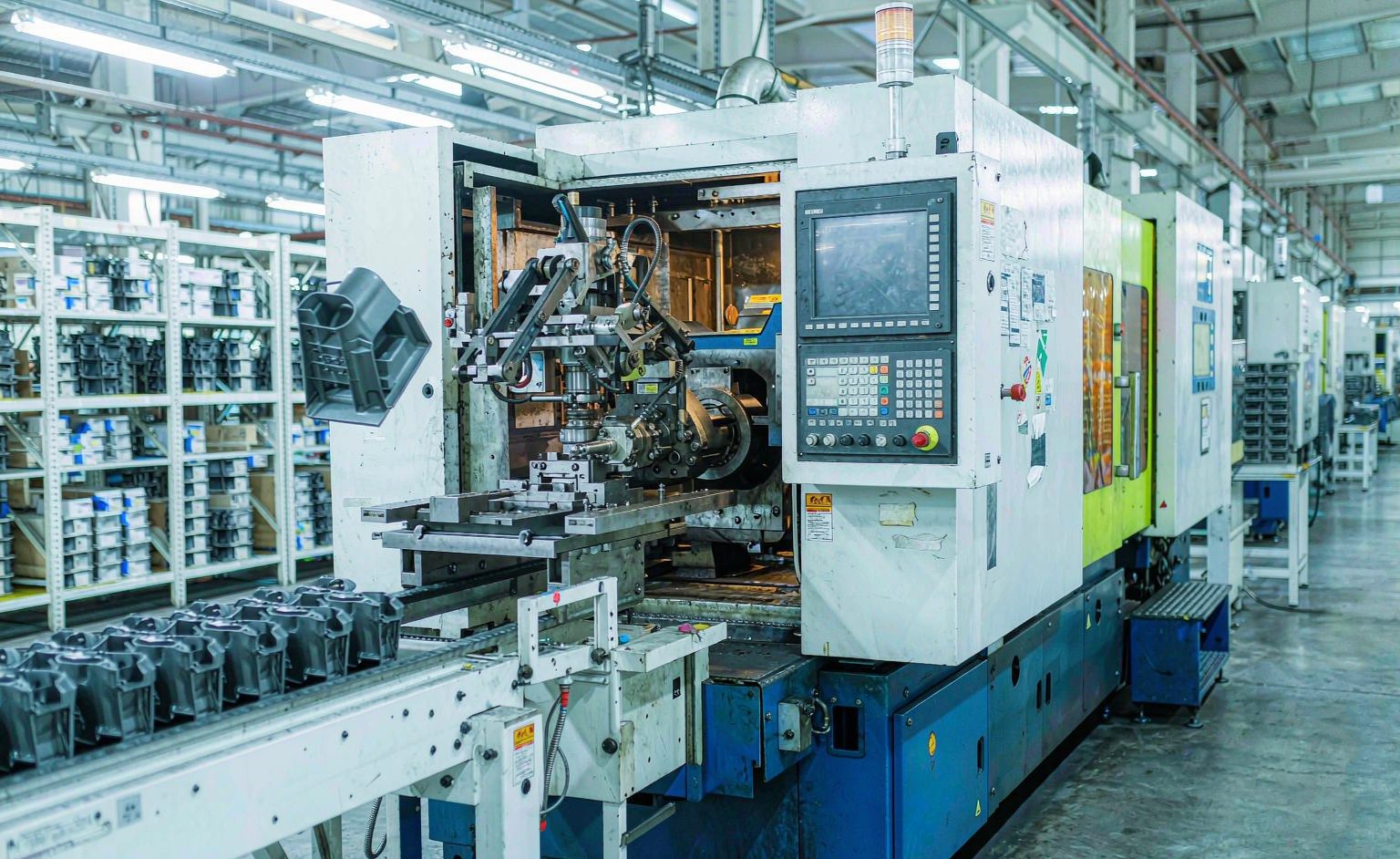
Two moulders can quote the same drawing and land 40% apart, and neither is necessarily wrong. Injection moulding cost is not a single number applied to a part; it is a sum of tooling, material, machine time and amortisation, each driven by decisions the buyer made long before the quote arrived. Buyers who understand the cost structure negotiate on the right variables. Buyers who do not, negotiate on price alone and get the cost back in tooling changes. This guide breaks the quote apart.
Principais Conclusões
- Unit price is mostly tooling amortised over a part count, plus resin, plus machine minutes — the three move independently.
- Tooling cost is driven by cavity count, complexity and steel, not by part size alone.
- Cycle time is the single variable a buyer can most directly reduce, through wall thickness and design.
- A quote is only comparable against a stated annual volume; the same part is cheap at one volume and expensive at another.
- DFM feedback before tool cutting is where the largest savings are available — and the cheapest.
The Four Components of a Moulding Quote
Every injection moulding price is built from four components. Knowing which one dominates tells you where to negotiate.
| Componente | What it covers | O que o impulsiona |
|---|---|---|
| Tooling | Mould design, steel, machining, fitting, trial | Cavity count, part complexity, tool steel grade, slide/action count |
| Material | Resin plus masterbatch and regrind allowance | Resin grade, price volatility, colour, filler content |
| Machine time | Press time per cycle, including cooling | Cycle time, press tonnage, cavitation |
| Amortisation | Tooling spread across the committed part count | Annual volume and the total committed quantity |
The amortisation line is where most quote disputes originate. A moulder quoting a low unit price has usually assumed a high annual volume over which to spread the tool; a moulder quoting a high unit price may be amortising over a conservative volume or none at all. Two quotes for the same part are only comparable when both state the assumed volume. Ask for it in writing.
Tooling: What Actually Moves the Number
Tooling is the largest single line in most first-year quotes, and buyers routinely misjudge what drives it. Part size matters far less than part complexity.
| Tooling driver | Cost effect | Buyer lever |
|---|---|---|
| Número de cavidades | Near-linear: a 4-cavity tool costs roughly more than a 1-cavity tool | Match cavitation to volume, not to ambition |
| Undercuts and slides | Each action adds design, machining and maintenance | Design out undercuts where possible |
| Tool steel grade | Harder steel costs more and lasts longer | Match steel to expected total volume |
| Surface finish / texture | Polishing, etching and texture add process steps | Limit the number of distinct finishes |
| Tight tolerances | More fitting iterations and longer trials | Relax tolerances that do not affect function |
The single highest-leverage decision is cavity count. A four-cavity tool produces four parts per cycle, which reduces machine minutes per part — but it costs more to build and requires a volume that justifies it. A buyer who orders a four-cavity tool for a low-volume part has bought machine-time savings they will never collect. The tolerance discipline that keeps tooling affordable is covered in our injection moulding tolerances guide.
Material and Resin Selection
Resin is usually the second-largest recurring cost, and it is the component most exposed to market movement. Grade selection is therefore both a technical and a commercial decision.
| Resin family | Typical positioning | Cost consideration |
|---|---|---|
| PP | Low cost, good chemical resistance, flexible hinge applications | Usually the lowest-cost engineering option |
| ABS | Good stiffness and finish, common in consumer housings | Mid-range; sensitive to grade and colour |
| PC | High impact and clarity, higher temperature | Higher base cost than PP/ABS |
| PA (náilon) | Wear and temperature performance, absorbs moisture | Higher cost; drying and handling add process cost |
Ask three material questions in every quote: is the price based on a quoted resin grade with a stated index, what regrind policy applies, and how is price movement handled over the tool life. A quote that names no grade is not a quote. Material trade-offs for common applications are compared in our PP vs ABS vs PC comparison.
Cycle Time: The Variable You Control
Machine minutes are the recurring cost a buyer can most directly reduce, and the lever is design, not negotiation. Cycle time is dominated by cooling, and cooling is dominated by wall thickness.
| Design factor | Effect on cycle | What good looks like |
|---|---|---|
| Espessura da parede | Cooling time scales roughly with the square of thickness | Uniform, nominal walls; no thick spots |
| Ribs vs solid bosses | Ribs cool faster than solid sections | Ribbed structures instead of thick bosses |
| Ângulos de extração | Low draft extends cycle and risks damage | Consistent draft on all vertical faces |
| Gate and runner design | Poor filling forces longer cycles | Balanced fill, appropriate gate count |
This is why DFM feedback before tool cutting is worth more than any price negotiation afterwards. A 15% cycle reduction on a high-volume part is a permanent saving on every part for the life of the program; a 15% price concession is usually a one-time adjustment. What to expect from that review is covered in our guide to comparing moulding and 3D printing for prototypes.
Reading Two Quotes Against Each Other
Build a comparison table before the second quote arrives: tooling cost, cavity count, resin grade, quoted cycle time, assumed annual volume, amortisation basis, and the tolerance the quote assumes. Any field a moulder will not state is a field where the cost is hiding. The moulder who states all seven is usually the one whose price holds.
One more check: ask what the quote excludes. Design changes after the first trial, texture, secondary operations and packaging are commonly outside the quoted price and commonly needed. The defects that drive rework cost — and therefore the real price of a marginal quote — are covered in our injection moulding defects guide.
Perguntas Frequentes
What determines the price of an injection molded part?
Four components: tooling, material, machine time and tooling amortisation over a committed volume. Unit price is only meaningful when the assumed volume and amortisation basis are stated.
Why do two quotes for the same part differ so much?
Usually because they assume different volumes, cavity counts, cycle times or tolerance levels. A quote is not comparable until the assumed annual volume and amortisation basis are both known.
Does part size drive tooling cost?
Much less than complexity. Undercuts, slide actions, tight tolerances and cavity count move tooling cost far more than overall part dimensions do.
How does wall thickness affect cost?
Directly, through cycle time. Cooling time scales roughly with the square of wall thickness, so a thick section lengthens every cycle and adds material. Uniform nominal walls are the cheapest design.
What is tooling amortisation?
Spreading the tool cost across the committed part count instead of paying it all upfront. The unit price depends entirely on the assumed volume, which is why that assumption must be in writing.
How many cavities should my tool have?
Enough to serve the volume without paying for idle capacity. More cavities reduce machine minutes per part but cost more to build, so the number should match real demand, not a hoped-for one.
What can I do before tooling to reduce cost?
Get DFM feedback on wall thickness, draft angles, ribs versus solid bosses and gate design. Cutting cycle time and avoiding design changes after the first trial is where the largest permanent savings are available.
Fundamentos técnicos: moldagem por injeção, design para manufaturabilidade e thermoplastic processing explain the process and the design principles referenced above.