




Two electronic dartboards can look identical on a showroom table and be sellable in completely different parts of the world, and the difference is almost always power. The supply design, the plug on the adapter and the certifications attached to it decide which markets a unit can legally enter, and they are far cheaper to decide before the order than to fix after it. For a buyer specifying an electronic dartboard for export, power is a market-access question before it is an engineering one.
There are three common architectures, and each carries a different cost, certification and user-experience profile.
Adapter-Fed, Mains-Fed or Battery
The dominant design is an external AC adapter feeding a low-voltage DC input on the board. It keeps high-voltage parts outside the product, which simplifies safety approval of the board itself, and one board can serve many markets by changing the adapter. The trade-off is cost per unit, adapter loss and the reality that adapters get lost, which is a support ticket category of its own.
A mains-fed design brings AC directly into the board through a captive cord or an inlet socket. It removes the adapter from the bill of materials and the from-the-box experience, but it makes the board itself a mains appliance: full safety approval, stricter internal clearances and creepage distances, and a design that is locked to one voltage region unless the internal supply is multi-range.
Battery operation – usually D cells on family boards – widens where the board can be hung and keeps the product selling in markets where a mains socket near the dartboard wall is not guaranteed. It is slow to score on cost per hour of play, but as a secondary option alongside an adapter input it removes a purchase objection cheaply.
Voltage Range and What “Universal” Actually Requires
Mains voltages fall into two families: roughly 100-127 V in North America, Japan and parts of Latin America, and roughly 220-240 V nearly everywhere else. A board intended for global export should therefore specify a 100-240 V, 50/60 Hz input on the adapter, which is now a commodity capability and costs little more than a fixed-range part.
The common mistakes are subtle. An adapter with the right voltage but the wrong frequency behaviour can misbehave on 50 Hz supplies. A “universal” input claimed on the box but implemented with a marginal component gets through a warm showroom and fails in a hot room over a long session. And the DC barrel plug on the board side must be specified with the same care as the mains plug – polarity, outer diameter, inner diameter and current rating – because a field-swapped third-party adapter is the leading cause of dead units and warranty arguments.
- State the input as 100-240 V, 50/60 Hz on the adapter and in the manual, not as a marketing line but as a tested requirement.
- Mark the DC input on the board with voltage, polarity and current so replacement adapters can be matched without contacting support.
- Define the adapter as a spare part with a part number, so post-sale support has an answer that does not involve replacing the board.
Plug Types by Destination Market
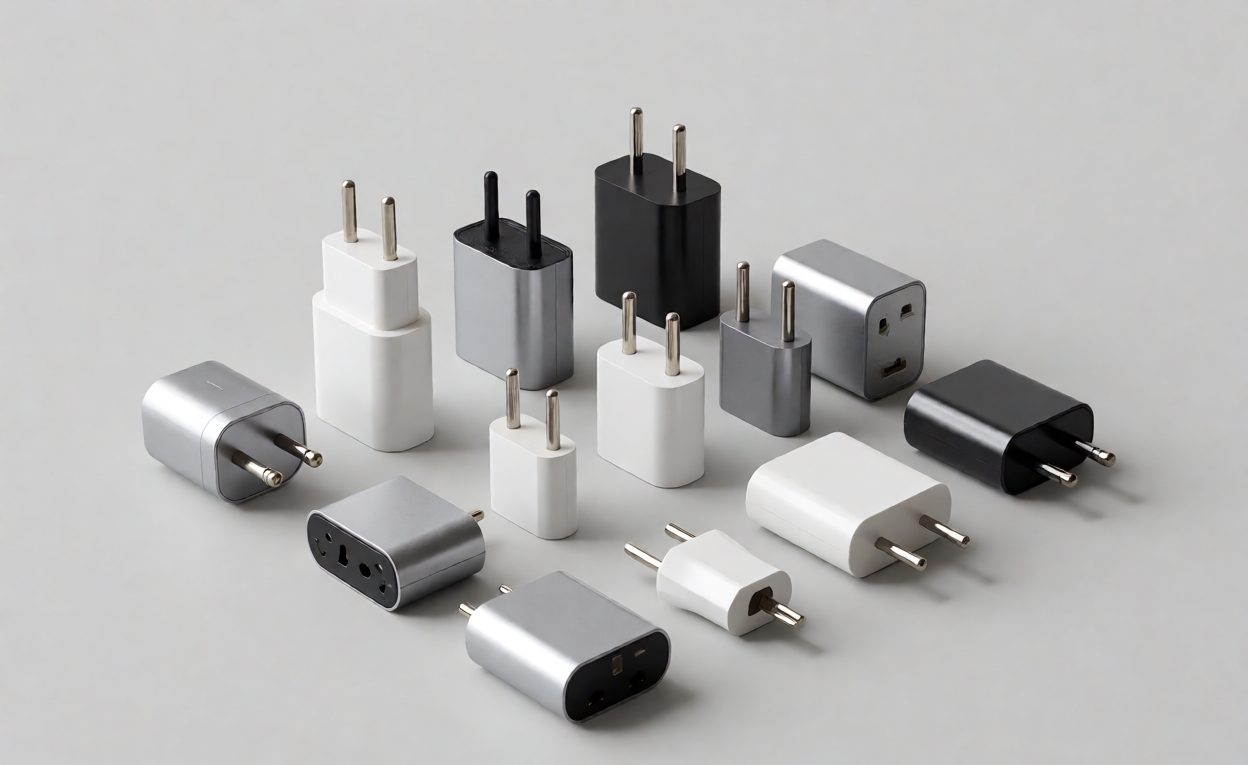
Mains plug patterns are set by country, and they are not negotiable at the border. The practical mapping for export planning is straightforward: flat parallel pins for North America and Japan, round pins for most of continental Europe, a three-pin fused plug for the United Kingdom and Ireland, and an angled flat-pin pattern for Australia and New Zealand, with further variants across Latin America, Asia and Africa. Some markets accept more than one pattern, but the adapter sold into a country should carry its primary pattern – a plug that needs a second adapter to be usable is a return waiting to happen.
For a programme spanning several regions, two structures work. Interchangeable-head adapters, where one body accepts clip-on country heads, consolidate the electronics and localise only the head. Or separate single-market adapters, ordered by destination and packed per region, which is simpler per SKU but fragments the forecast. The right choice depends on how the order splits by region; the wrong choice shows up as dead stock in exactly one country.
Certification: The Gate Before the Plug
The plug is the visible part of a certification package, and the package differs by market. North America requires recognition of the adapter under the relevant safety schemes and, for the board’s radio features, additional equipment authorisation. The European Union requires CE marking backed by the low-voltage and electromagnetic compatibility directives, and the United Kingdom now carries its own marking. Australia and New Zealand have declared-equipment rules that touch power supplies directly; Japan has its PSE round; several Gulf and Asian markets add their own registration steps.
What matters for the buyer is not memorising the list but assigning it. The specification should name the destination markets, require the corresponding adapter certificates with report numbers, and make the certificates a condition of shipment. A factory that says “we do CE” without producing the report for the actual adapter model in the actual configuration has said nothing.
- Name markets, not regions. “Europe” is not a certification; a country list is.
- Certify the exact adapter SKU, including the plug head, not a representative one.
- Match the marking artwork – rating labels, warning text and markings must match the certified unit.

What to Specify on the Order
One line covers the electrical core: 100-240 V 50/60 Hz external adapter, certified per named destination market, with the DC output, barrel dimensions and polarity stated on both the adapter label and beside the board’s input socket. Around it sit the commercial decisions: which plug variants per market, whether battery operation is offered alongside, how spare adapters are provisioned, and what the manual says about third-party adapters. Each is cheap to fix in the specification and expensive to fix in a container.
Then test like the customer lives: a long scoring session on the lowest and highest voltage a market can supply, a hot room, and a plug-in, unplug, repeat cycle on the barrel socket, which is the part that wears first in family use.
Technical Background
The plug patterns an exporter deals with are documented in the family of AC power plugs and sockets standards, and the underlying voltage and frequency differences follow from the history of mains electricity deployment by region. On the board side, the external unit is a conventional power supply converting mains to low-voltage DC, which is why the certification burden sits on it rather than on the board in adapter-fed designs.
How Power Connects to the Rest of the Board
Power decisions interact with the electronics specification, the segment assembly and the markets the catalogue targets. The due-diligence list for the whole unit is covered in the electronic dartboard OEM checklist, and the darts it pairs with in the soft-tip dart specification. The playing surface itself – segment plates on an electronic board – is compared in the dartboard materials comparison, with the wider product family in the dartboard types overview. Where the programme includes coin-operated equipment, the mains and service implications extend further, as described in the coin-operated machine buying guide.
Frequently Asked Questions
Should the board use an external adapter or built-in mains?
An external adapter for export programmes. It keeps certification simpler, lets one board serve many markets and isolates mains parts from the product.
What input range should the adapter have?
100-240 V, 50/60 Hz, tested rather than merely claimed, so a single adapter SKU covers both voltage families.
Can one plug type serve several countries?
Sometimes, but the adapter sold into a market should carry that market’s primary plug. Adapters requiring a second adapter generate returns.
Is battery operation worth offering?
As a secondary input, yes. It widens where the board can be mounted and removes an objection in rooms without a nearby socket.
Which certifications does an adapter need?
Whatever the named destination market requires – safety marking plus radio authorisation where applicable – with report numbers for the exact adapter SKU.
What fails first in family use?
The barrel socket from repeated plug cycles, and lost adapters. Specify the adapter as a numbered spare part to cover both.
How should power be verified before shipment?
Long sessions at both ends of the voltage range, in hot conditions, with repeated plug cycles on the DC socket.