



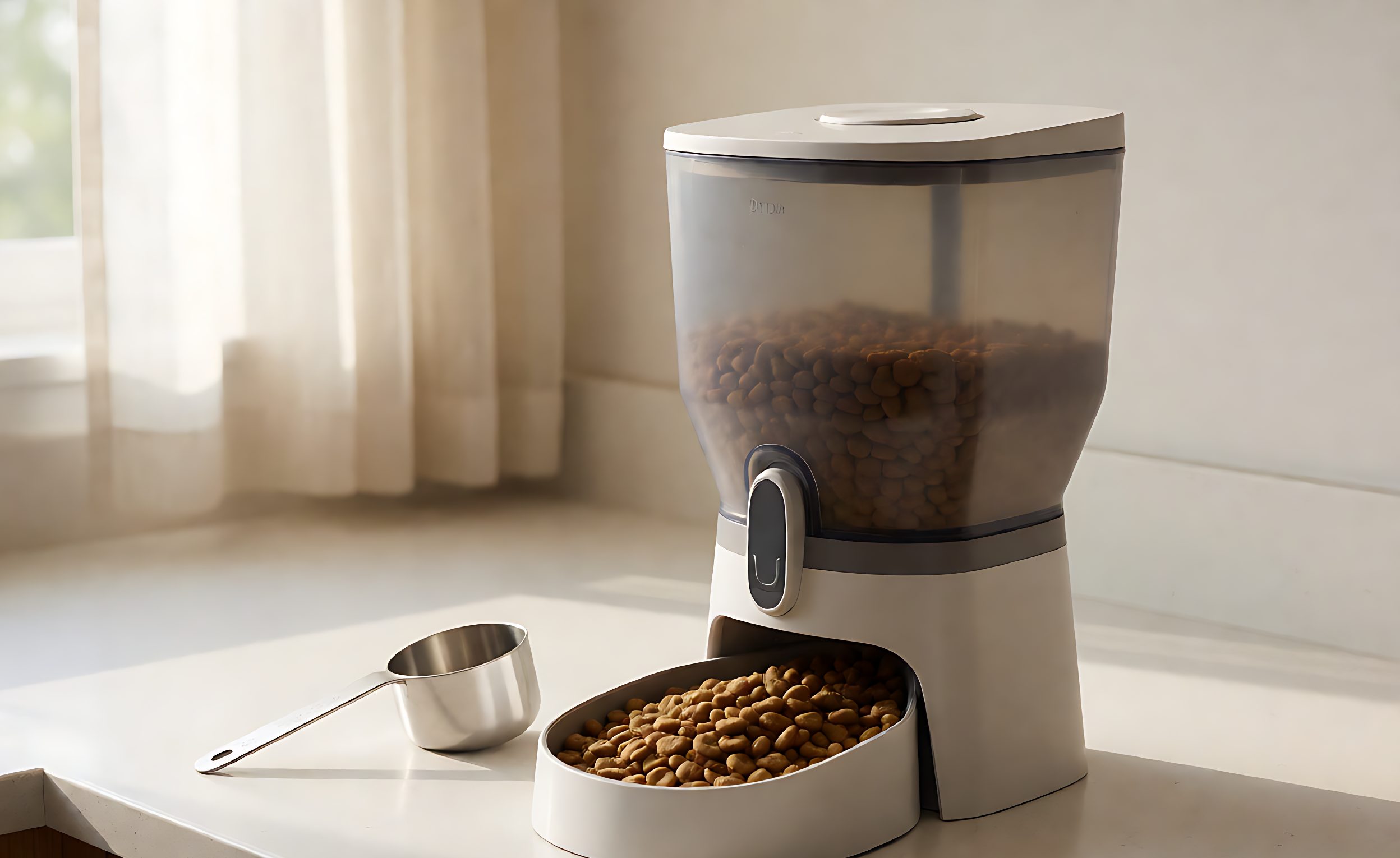
Hopper capacity is the first number a pet feeder buyer compares and one of the least useful on its own. Four litres on a small-breed feeder and four litres on a large-breed feeder represent completely different amounts of autonomy, and neither figure says how much of that volume the mechanism can actually reach. What matters is days of unattended feeding for the household the product is sold into, and the specification should be written backwards from that number.
Capacity also shapes the product itself: height, footprint, carton volume and the visual mass on the counter, which decides whether the unit fits under a kitchen cabinet.
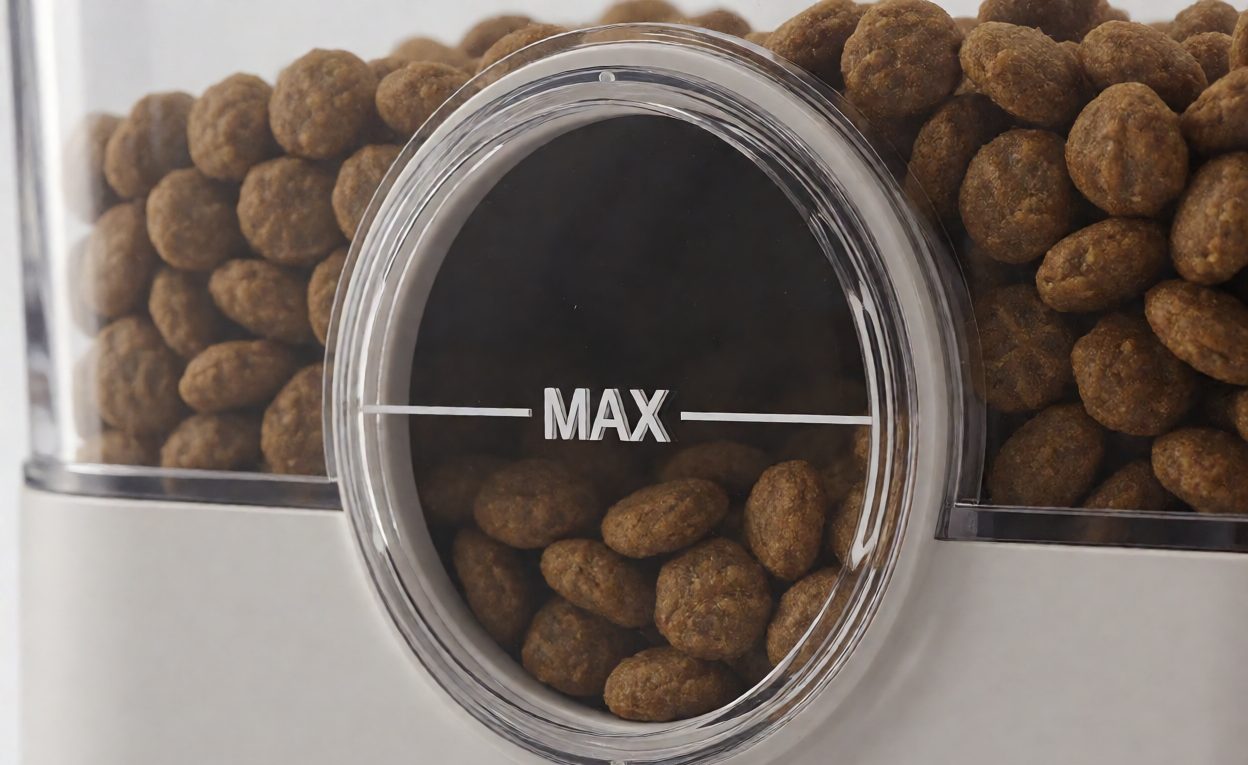
Start From Days of Autonomy, Not Litres
Choose an autonomy target from the intended pet count, feeding plan, portion size, food type, and customer use case. State the daily-portion and kibble-density assumptions so buyers can translate hopper volume into days without treating one duration as suitable for every household.
- Daily portion in grams – state the assumption rather than only the resulting capacity.
- Kibble bulk density used for the conversion – a capacity in litres is meaningless without it.
- Days of autonomy printed on the pack – the figure customers actually shop on.
Usable Volume Is Never the Nominal Volume
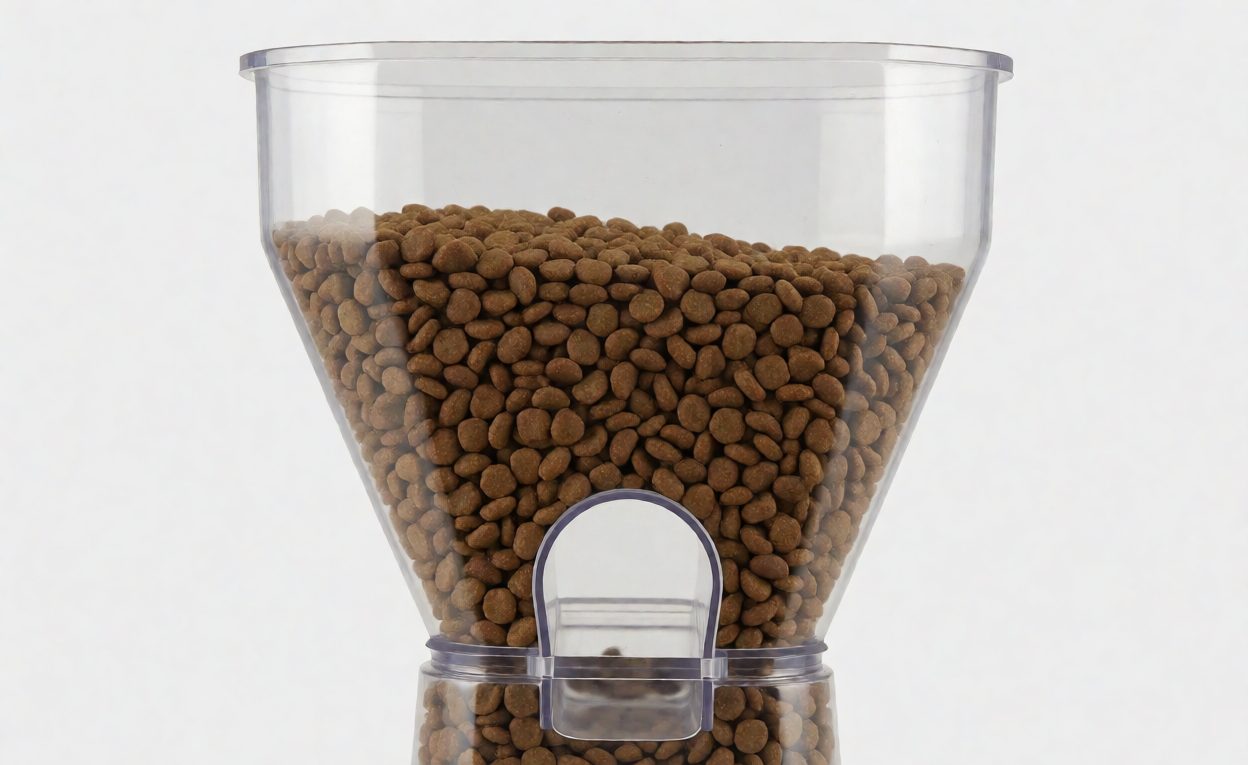
Every hopper has a nominal volume and a usable one, and the gap is where capacity complaints come from. Kibble does not flow to the last grain: once the food column drops below a certain height, the mechanism stops picking it up reliably and the unit dispenses short while the window still shows food. That dead volume can be a meaningful fraction of a small hopper.
Geometry decides the size of the gap. A steep taper with a smooth, wide outlet leaves little behind. A tall, narrow column with sharp shoulders promotes two failure modes: bridging, where grains arch across the outlet and stop flow entirely, and rat-holing, where a vertical channel empties while the food around it stays put. Both reach the customer as an empty bowl under a hopper that still looks half full.
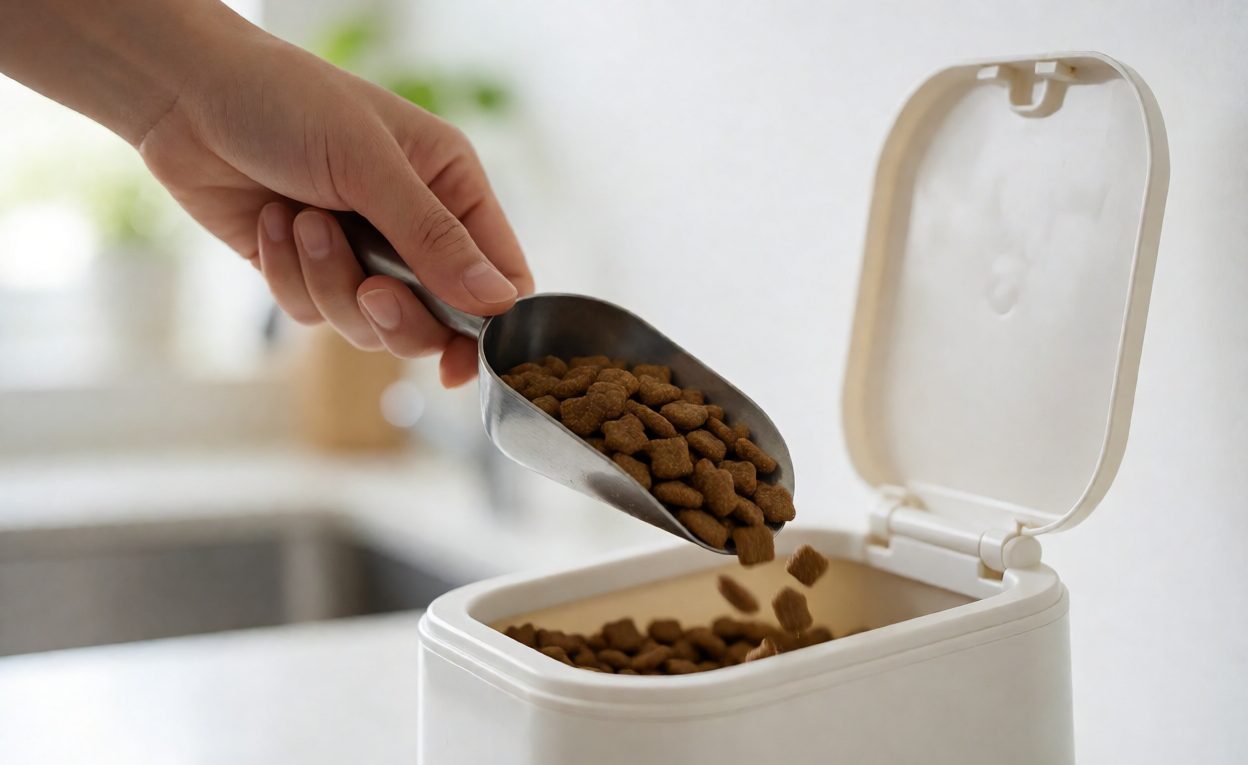
Refill UX: Lid, Window and Low-Food Sensing
Refill is a recurring interaction with the hopper. Compare lid opening, pouring, visibility, cleaning access, and closure security with the bags and household conditions the product targets.
Sensing should be specified by behaviour rather than by sensor type. The low-food warning needs enough margin that the customer sees it before the last day of food, and the app should express the remainder in days where it can. A hard empty state needs a defined behaviour too: a clear alert and a stopped schedule, never a silent missed meal.
Freshness, Humidity and the Desiccant Provision
A larger hopper can reduce refill frequency but may keep food in the device longer. Validate lid closure, outlet cleanliness, food residence time, and cleaning access with the intended kibble; a desiccant is not a universal substitute for correct storage.
- Gasketed lid with defined compression, verified over repeated open and close cycles.
- Replaceable desiccant compartment sized to hopper volume, with a stated replacement interval.
- Removable hopper that a customer can wash without tools.
What to Put on the Order
- Nominal capacity in litres plus the bulk density used to convert it.
- Usable capacity, measured to the point where dosing errors begin.
- Days of autonomy at stated daily portions, as the headline figure on the pack.
- Refill ergonomics – one-hand opening, stay-open lid, spout-compatible mouth.
- Notification behaviour for low food and empty states, defined in the app.
Technical Background
The FDA advises consumers to keep dry pet food in its original bag where possible, or use a clean, dry container with a well-fitting lid and retain lot and date information. See FDA pet-food storage guidance; validate feeder capacity and flow separately with representative kibble.
Where This Fits in the Feeder Programme
Capacity is the front end of the feeding system; dosing behaviour is covered in the portion-accuracy and calibration guide and the jam-testing guide. Test auger delivery with representative kibble and defined fill levels, and confirm that any hopper lid stays closed during refill and handling. Capacity tiers for a wider product line are discussed in the automatic pet feeder OEM guide.
Frequently Asked Questions
How many days of autonomy should a feeder target?
Set the target from pet count, feeding plan, portion size, kibble density, and the intended household. State those assumptions with any autonomy claim.
Why does a full-looking hopper stop dispensing?
Bridging or rat-holing can interrupt flow, depending on kibble and outlet geometry. Test with representative food types and fill levels.
Should capacity be stated in litres or days?
Both can be useful. State the food density and daily portion used to convert volume into an autonomy estimate, and avoid treating the result as universal.
Does a bigger hopper keep food fresh?
A bigger hopper can reduce refill frequency but does not guarantee freshness. Validate closure, cleaning, and storage with the intended kibble and follow its storage instructions.
What counts as usable capacity?
The amount dispensed before the device no longer meets its dosing criteria under the stated food and fill conditions. Measure it on production-equivalent units.
When should the low-food alert trigger?
Set the alert early enough for the intended user to refill before the feeder runs out, based on measured capacity, notification delay, and the product use case.
Should the hopper be removable for washing?
A removable or otherwise accessible design can make cleaning easier. Validate the cleaning method and tell users to follow the food and product care guidance.