




During the injection molding of plastic shells, many clients are most concerned with the specifics of mold creation when choosing a plastic mold processing factory. Simply put, if there are flaws in the product, they can often be attributed to the polymer’s molecular weight being significantly higher than that of surrounding polymers, or excessive polymerization. However, many are unaware of the potential economic losses associated with defects arising in the plastic mold processing process.
- Impact of Raw Materials
In the plastic mold processing process, the quality of raw materials plays a critical role in the final product. Residual catalysts in the material are often one of the contributing factors. Additionally, the design of the equipment can also cause issues. For example, an improperly designed die head on a film-blowing machine can create dead zones where small amounts of material are subjected to prolonged heat exposure, leading to excessive polymerization or degradation, ultimately affecting product quality. Long-term carbon buildup on the screw can form gel points, which may trap impurities and potentially transfer them to the film, creating crystallization.
To minimize crystallization, regular cleaning of molding equipment is essential. During production, certain catalysts may remain on the equipment surfaces, continuing to catalyze the polymer at high temperatures and leading to further polymerization reactions.
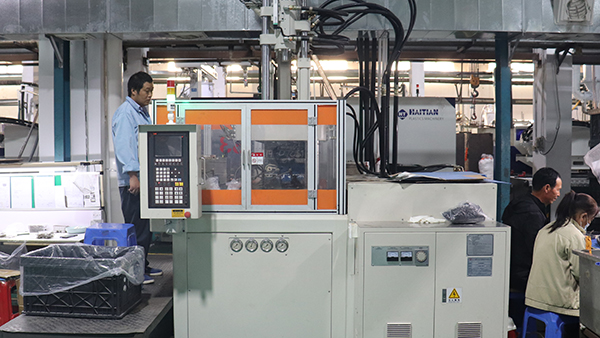
- Impact of Polymer Oxygen Content
In actual processing, the oxygen content within the polymer also affects product quality. High oxygen content in polymers may lead to the formation of free radicals on the surface. These free radicals, acting as active centers, can trigger reactions with other polymer molecular chains, leading to unstable polymer formation. At high temperatures, the color of the polymer may also change, which is one of the main reasons for crystallization. Adding an appropriate amount of antioxidants can effectively prevent the formation of crystals.
DAYIN Plastic Products Co., Ltd. has specialized in mold manufacturing for 30 years, offering one-stop OEM/ODM services as an injection molding contract manufacturer. We excel in optimizing product structures to reduce mold opening and injection molding costs. With a complete product design and manufacturing team, we provide high-quality product design services and are equipped with advanced mold processing equipment and extensive mold-making experience to deliver various plastic products to our clients. Our production facility spans 50,000 square meters, with 30 years of mold development experience, over 50 R&D personnel, and more than 100 injection molding machines, all dedicated to providing high-quality products to our clients.
Crystallization in Plastic Shells: The Chemistry That Shows
Crystallization in molded shells is chemistry made visible. The visible forms and their meaning:
| Visible form | Chemistry behind it | Control that manages it |
|---|---|---|
| Shrinkage variation across walls | Thick sections crystallise more | Uniform wall design |
| Opacity where clarity expected | Spherulites scattering light | Fast cooling, nucleation control |
| Warp along flow directions | Anisotropic crystal orientation | Balanced fill, controlled cooling |
| Post-mold dimension drift | Slow crystallisation after ejection | Conditioning before final gauge |
The opacity row is the classic semi-crystalline surprise: resins that mould clear in thin fast-cooled sections turn hazy where walls thicken and cooling slows, because spherulites grow where time allows — and the optical property is decided by the thermal history, not the resin alone. The post-mold row explains dimensions that change on the shelf: semi-crystalline parts continue tightening for hours after ejection, and gauging them warm measures a part that will not exist tomorrow — conditioning before final inspection is the discipline that keeps the capability study honest. The warp row ties crystallisation to orientation: crystals form along flow, shrink along flow, and pull the part toward the flow’s story. Crystallisation is thus not a defect but a behaviour — and designs and processes that respect the behaviour receive the resin’s strengths without its surprises. The shrinkage design half is in shrinkage minimisation, and the thermal context in mold temperature control. Reference: polymer crystallisation and crystalline resins.