



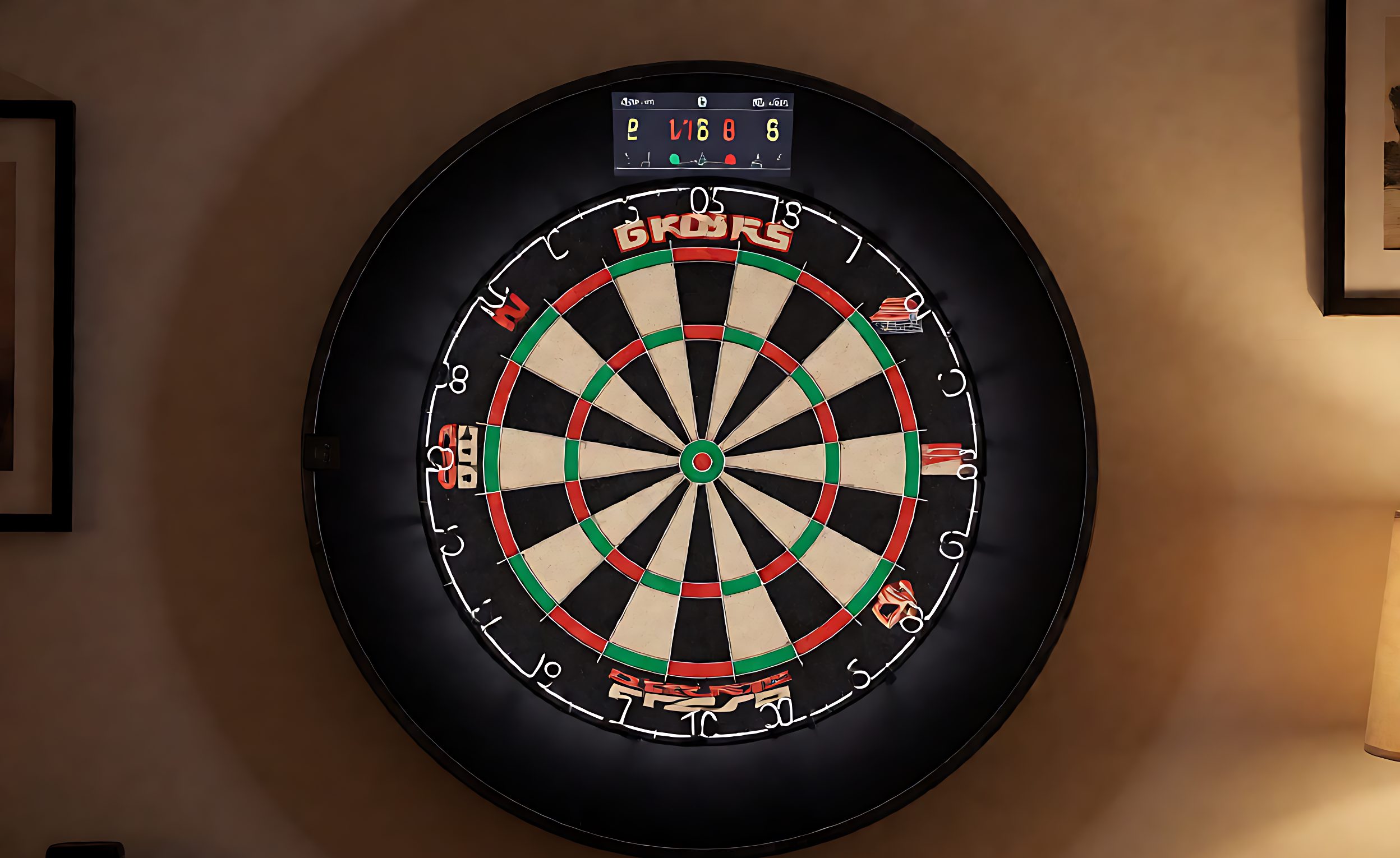
An electronic dartboard has one job that a bristle board does not: it has to decide, on its own, what a throw scored. Every complaint about the category – a missed triple, a phantom score, a segment that registers when nobody threw – is a complaint about that decision. For a buyer specifying an electronic board for a retail or OEM programme, scoring accuracy is therefore the specification that the product’s reputation rests on, and it is far easier to write down before an order than to negotiate after one.
Accuracy is also routinely oversold. Marketing copy says accurate scoring; what customers discover is that accuracy depends on the dart, the tip, the throw and the age of the segment plate. A good specification describes all four rather than asserting a single number.
How the Sensor Layer Registers a Hit
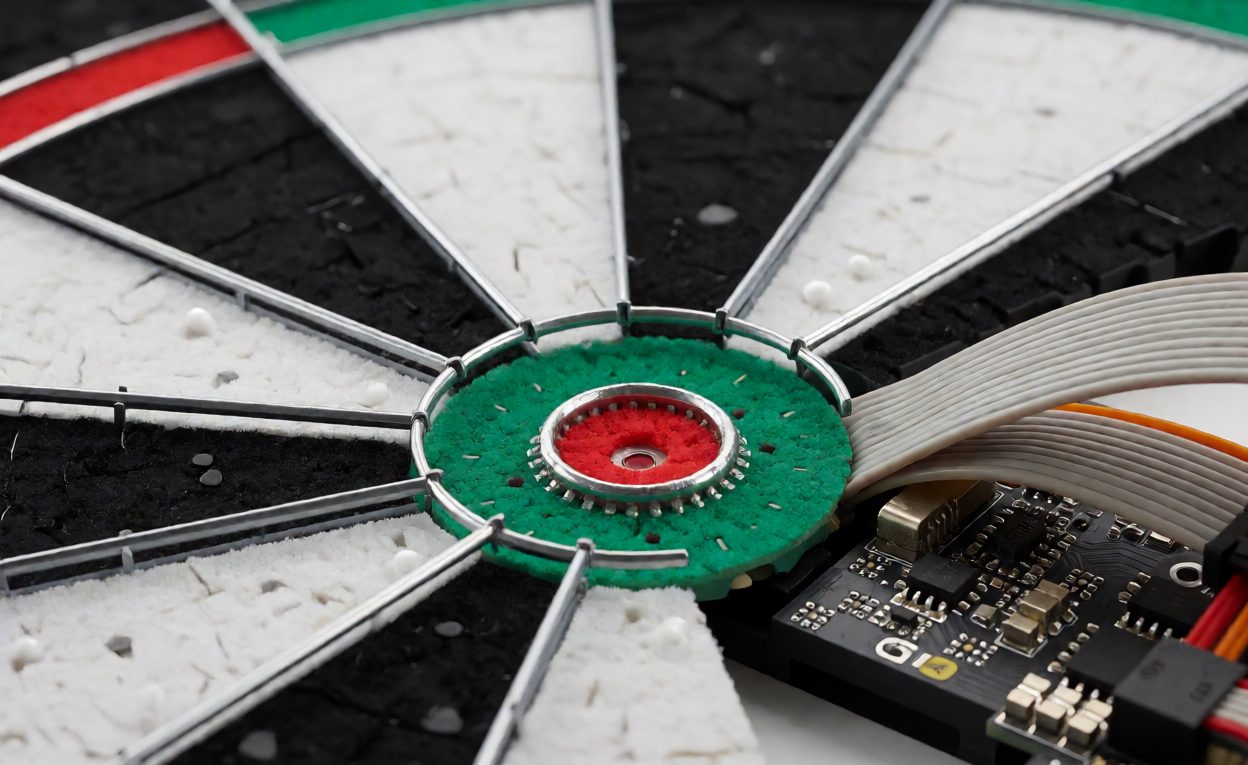
Commercial electronic boards use a matrix of segment plates behind a perforated face. When a soft-tip dart lands, it pushes into the segment, and the movement or the impact is detected by the sensor arrangement beneath – commonly a switch-closure or a strain-based detection across the plate, with a controller scanning the matrix and mapping the closed point to a score. The important consequence is that the board is detecting a mechanical event, not seeing a dart: it registers displacement or impact, and everything that changes that mechanical event changes the score.
That is why the same board behaves differently with different equipment. A fresh tip and a worn tip do not land the same way. A hard throw and a lobbed throw do not either. And a segment plate that has been struck tens of thousands of times no longer moves quite as it did on day one.
Accuracy Versus Repeatability
These two are constantly confused in supplier conversations and they are not the same property. Accuracy is whether the registered score matches where the dart actually landed. Repeatability is whether the same throw into the same segment produces the same result every time. A board can be highly repeatable while consistently mis-registering one band of segments, and it can be accurate on average while wandering enough to feel unreliable – and what players actually notice is the wandering.
So the specification should ask for both, expressed differently. Accuracy is a mapping check: throws into defined segments register the correct score, tested across the whole face rather than on a favourite triple. Repeatability is a statistical one: a defined number of throws into the same segment, on several production units, with a stated spread.
Bounce-Outs, Misses and Double Registration
The three failure signatures in the field are a throw that scores nothing, a throw that scores twice, and a throw that scores the wrong segment. Each has a distinct cause worth naming in the specification, because the fix differs.
- Missed registration – shallow penetration or a light throw that does not trigger the plate; the specification should state a minimum event threshold and how it was validated.
- Double registration – one throw counted twice, usually from a plate rebound or a dart that settles in two stages; debounce behaviour in firmware is the fix, and it should be tested rather than assumed.
- Wrong-segment registration – a dart that lands on a boundary and registers the neighbour, or a tip that walks on the face; segment geometry and plate isolation matter here.
What the Specification Should Say
A usable scoring clause names the dart and tip it was validated with, the throw energy range, the segment coverage, and the acceptance rate. Something of the form: with the supplied soft-tip darts and fresh tips, across a defined number of throws distributed over every scoring area, at throw speeds spanning light to firm, the board registers correctly at or above a stated percentage, with no double counting. That sentence is testable; “accurate scoring” is not.
Around it, several clauses are easy to forget and expensive to discover late:
- Tip condition – state that accuracy is claimed with tips in serviceable condition, and specify how worn tips should be handled, since worn tips are what players use.
- Segment wear life – a rated number of strikes before the plate layer needs service, with the replacement part defined as a spare.
- Bounce-out handling – whether the board detects and reports a bounce-out, and what the scoreboard does about it.
- Firmware behaviour – versioning and update path, because scoring behaviour is mostly firmware, not hardware.
- Displayed versus actual – the score shown must equal the score registered; a display bug is indistinguishable from a sensor bug to a customer.
The Test Protocol to Require
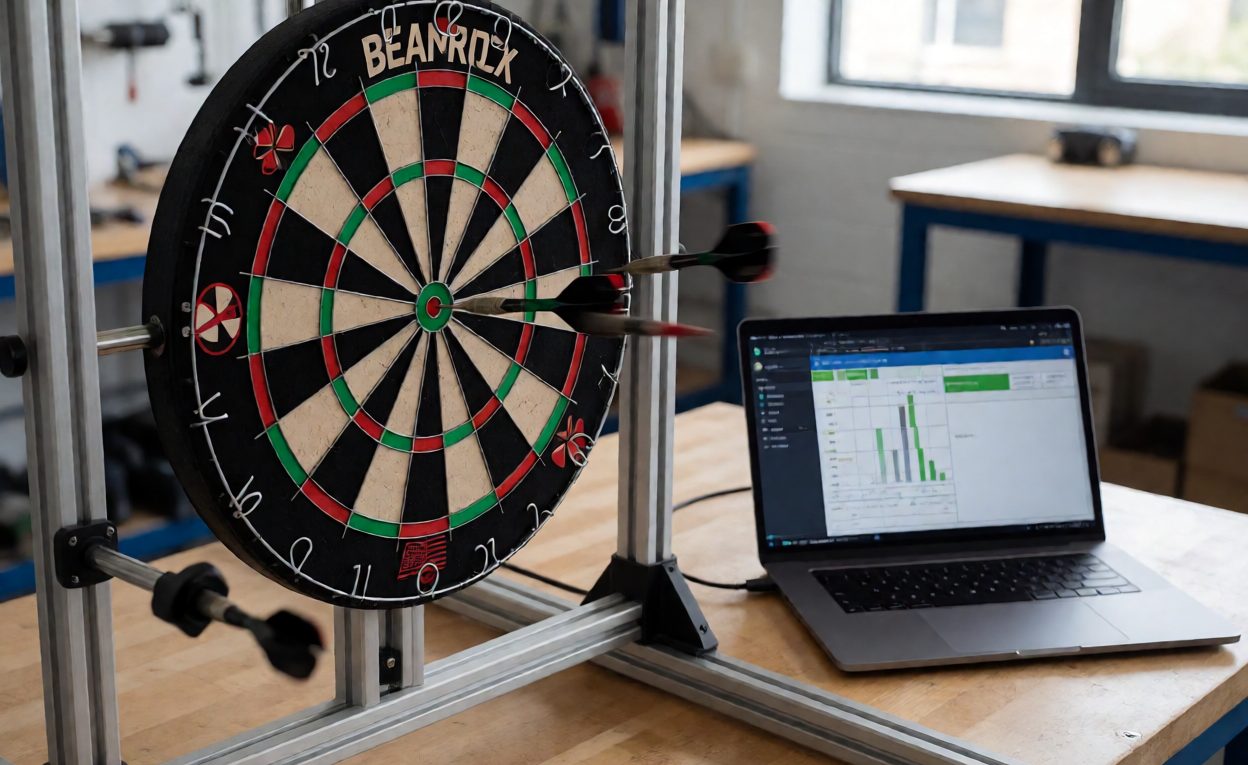
Run it on production units, not on demonstration samples, and use at least three. Distribute throws systematically rather than comfortably: every single, double and triple band, the bull and outer bull, and the boundary lines between segments, which is where mis-registration concentrates. Repeat each location enough times to see a spread. Vary throw energy deliberately from soft to firm. Then repeat the whole matrix with used tips, and again after a defined number of strikes on a single segment to approximate wear.
Log three numbers from that table: the overall correct-registration rate, the rate of double counting, and the spread across units. A board that scores well on the first and badly on the third has a production consistency problem that no amount of firmware tuning will fix, and it is the one that generates the reviews.
How Scoring Connects to Power and Electronics
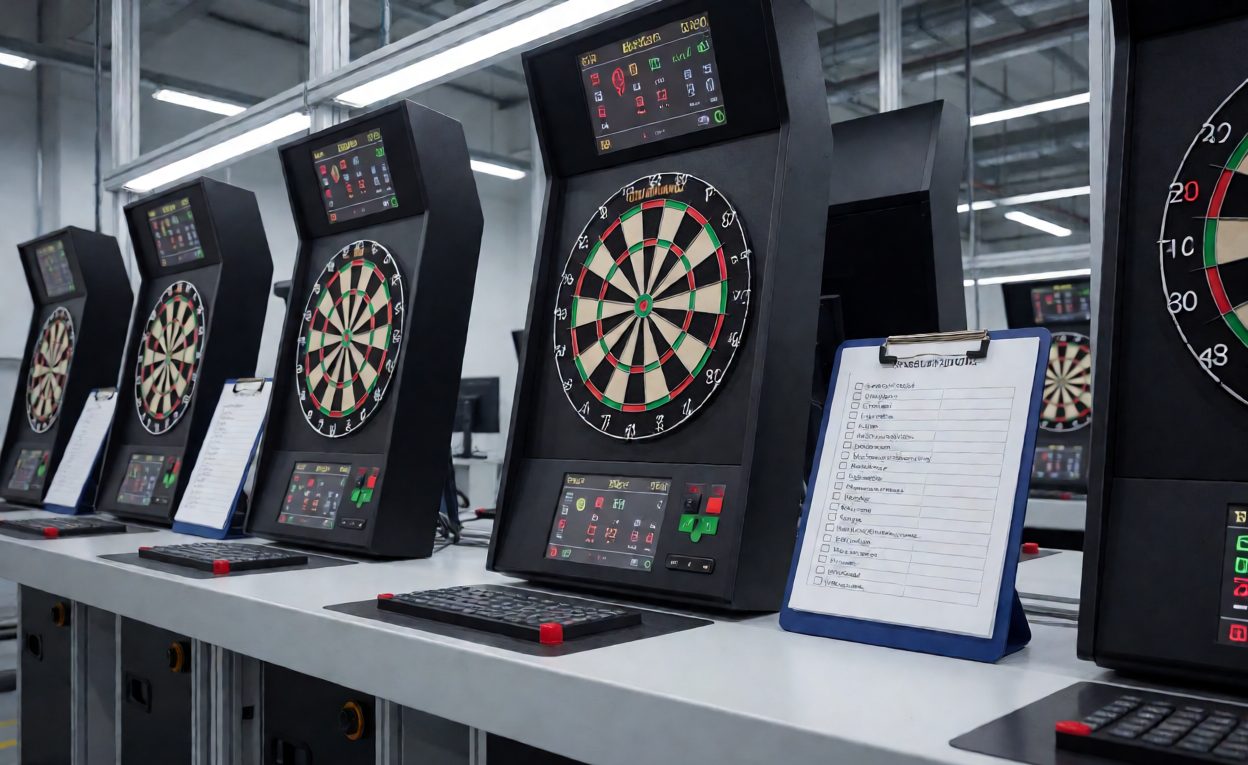
Sensor behaviour is the visible half of the electronics specification. The other half – supply design, plug types and market certification – is covered separately, and the two interact: a board that browns out under a weak adapter can behave as though its sensors are failing. When specifying a programme, treat the scoring clause and the power clause as one package and test them together, including a long session at the extremes of the adapter’s input range.
Technical Background
The segment plate and its detection layer are a form of sensor array, converting a mechanical event into an electrical one that a controller can read. Judging the result properly is the standard distinction between accuracy and precision – whether the registered score is right, and whether it is right consistently – and the two need separate tests. Some designs sense impact through the charge generated by piezoelectric elements, which is why throw energy and tip condition sit inside the accuracy claim rather than outside it.
Where This Fits in the Board Programme
Scoring is one clause of a larger due-diligence list for the whole unit, set out in the electronic dartboard OEM checklist. The supply and certification half is treated in the power supply and plug types guide, the darts that determine what the sensors actually feel in the soft-tip dart specification, and the consumer-facing comparison of boards in the electronic dartboard comparison. For the wider product family see the dartboard types overview, and for commercial installations where uptime and service access matter more, the coin-operated dart machine guide.
經常問的問題
What is the difference between scoring accuracy and repeatability?
Accuracy is registering the right segment; repeatability is registering the same result on the same throw every time. Players notice lost repeatability first.
Why does a board miss a throw sometimes?
Usually a shallow or light hit that does not trigger the plate, or a worn tip that does not transfer the impact. Both belong in the accuracy claim.
What causes one throw to score twice?
Plate rebound or a dart settling in two stages. Firmware debounce behaviour is the fix, and it should be tested rather than assumed.
Does tip condition really affect scoring?
Yes. The board senses a mechanical event, and a worn or damaged tip changes that event, so validate with both fresh and used tips.
How many units should be tested before ordering?
At least three production units, with throws distributed across every scoring band, boundary lines included, at both light and firm throw energies.
Do the segments wear out?
They do. Ask for a rated strike life for the plate layer and define the replacement as a spare part with a part number.
Can a power problem look like a sensor problem?
Yes. A weak adapter or a brown-out can produce mis-registration that looks like a sensor fault, so test scoring and power together.