



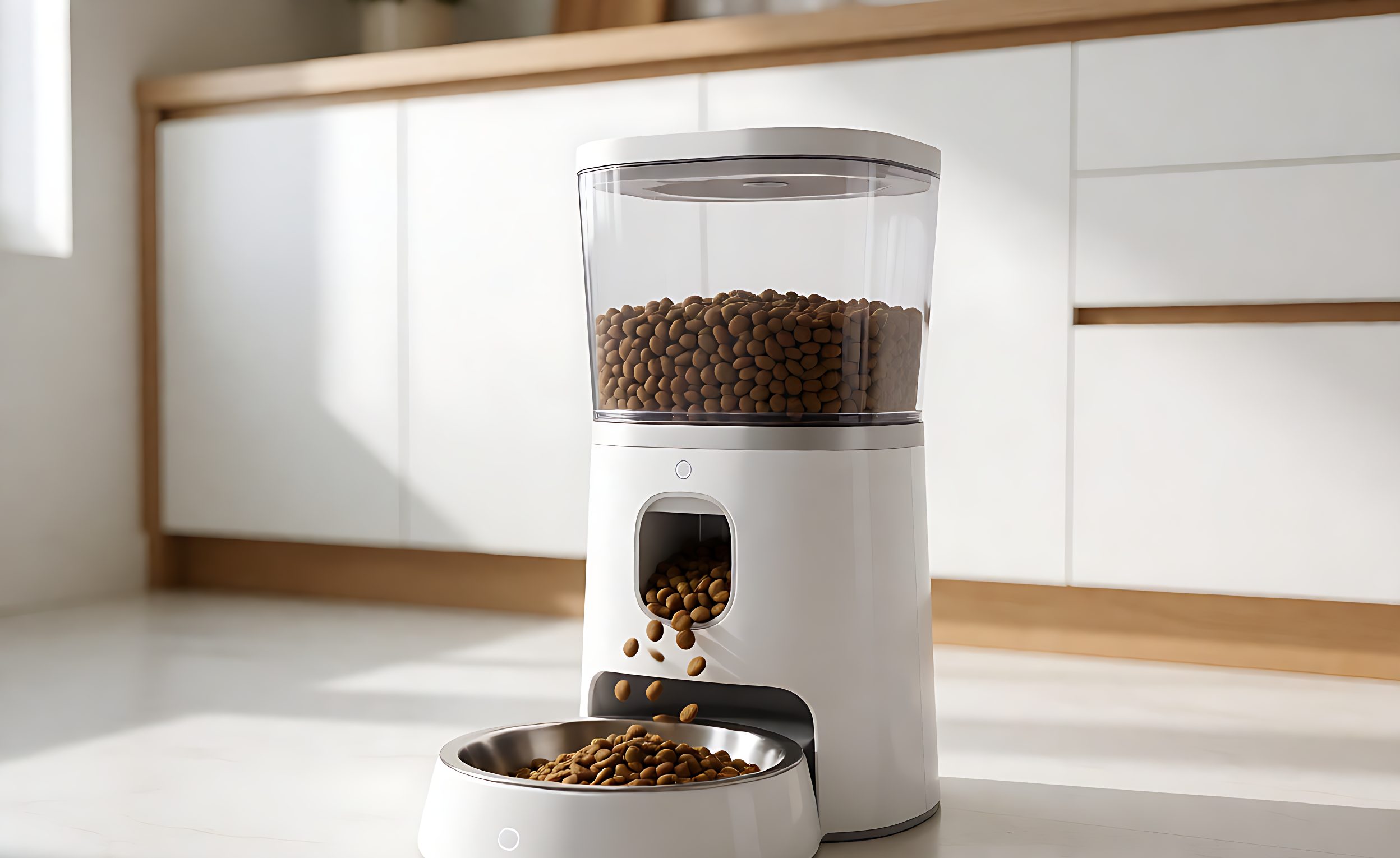
Every smart pet feeder makes the same promise: the right amount of food, at the right time, whether or not anyone is home. Almost every portion-accuracy complaint traces back to how loosely that promise was specified. Dosing is not a single number on a datasheet – it is the interaction of a mechanical doser, the physical behaviour of the kibble it is fed, and how the unit was calibrated. For a buyer specifying a feeder programme, all three belong in the specification.
The stakes are real. Under-dosing is a customer service email; over-dosing, on a pet with a weight-management plan, is a vet visit and a one-star review that names the product. The category’s returns are concentrated precisely where accuracy was assumed rather than tested.
Dosing Mechanisms and Where the Error Comes From
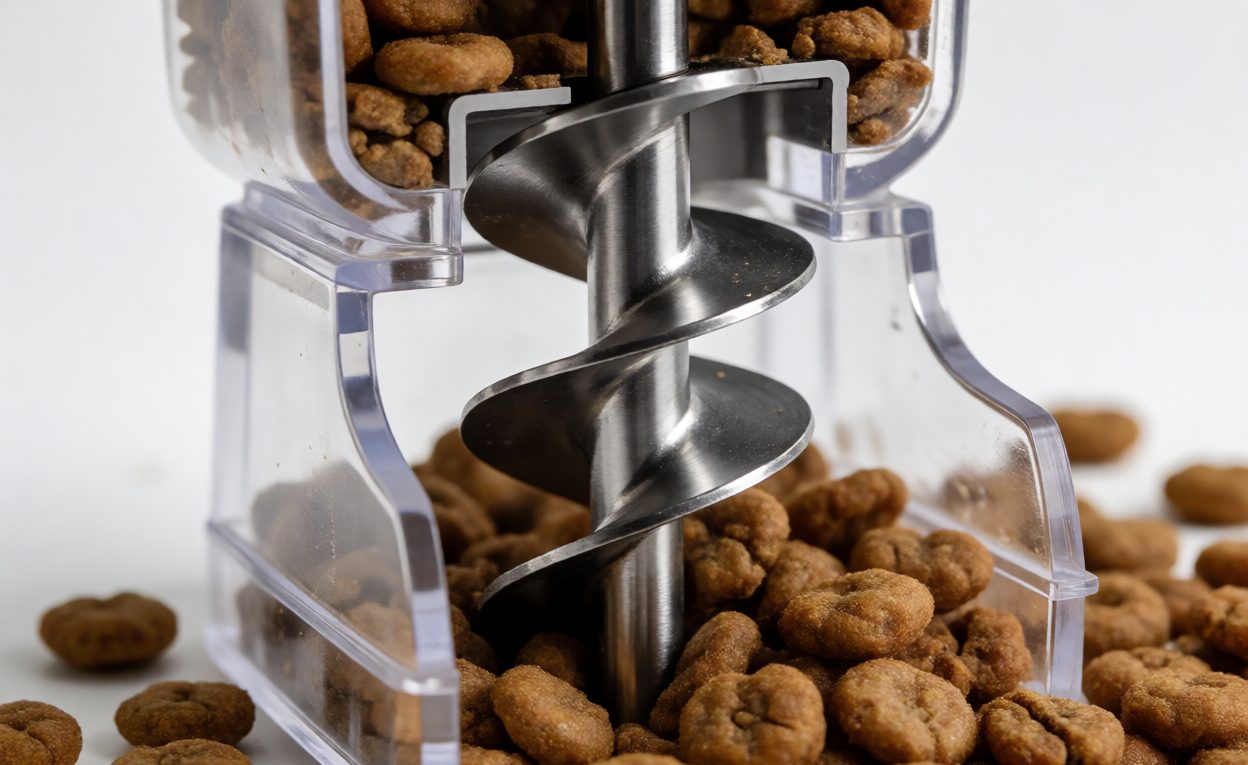
Two mechanisms dominate. An auger – a rotating screw in a tube – meters food continuously and handles a wide kibble range well, at the cost of a slightly “smeared” cutoff as grains dribble after rotation stops. An impeller or paddle gate releases fixed pockets of food and gives crisp cutoffs but is more sensitive to kibble size and bridging. Neither is inherently better; each pairs differently with the food the product will actually be sold alongside.
The error sources are consistent across both. Kibble that varies in size, shape or surface texture meters differently – kibble is a bulk solid, and its flow behaviour is a material property, not a machine constant. Humidity softens some formulas and changes flow. Hopper fill level affects the head of food pressing on the mechanism. And the mechanical parts themselves carry production tolerance: an auger tube that is marginally wider in one unit than another will deliver a marginally different portion at the same setting.
What a Portion Accuracy Claim Should Actually Say
“Accurate portions” is not a specification. A usable claim has four parts: a reference kibble (size and shape), a portion size or two, a tolerance, and a confidence statement across units. Something like: with a defined round kibble of 10-12 mm, a 50-gram portion delivers within a stated percentage across a defined number of units and hopper fill levels. That sentence is testable, and anything vaguer will be tested by customers anyway – they weigh portions the moment a pet gains weight.
Buyers should push for accuracy stated in grams against a weighed reference, not in “portions” or arbitrary units, because the app will display grams and the customer will compare against the feeding guide on the food bag. A feeder whose displayed grams drift from weighed grams by a consistent factor is a calibration problem; one that drifts randomly is a mechanical one, and the fix is different.
Calibration: Design It In, Don’t Leave It to Support
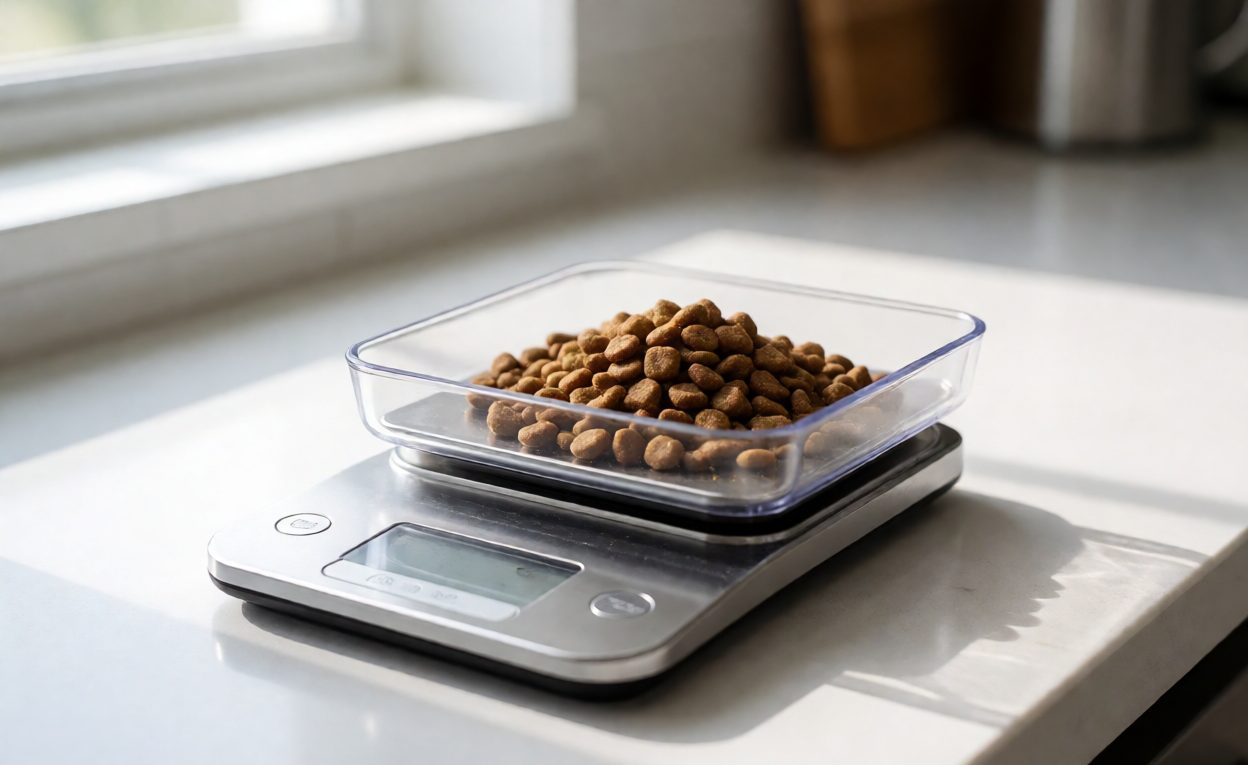
Because kibble varies by brand, every feeder needs a calibration path, and the best implementations make it a guided routine in the app rather than a line in the manual. The typical flow: dispense a multi-portion run into a bowl, ask the user to weigh it on a kitchen scale, and apply a correction factor to the dosing curve. A good system stores the correction per unit; a great one walks the user through it the first time with the app open.
The specification should cover the corners:
- First-run calibration – prompted on setup, not buried in settings.
- Recalibration after food changes – a new kibble is a new bulk solid, and the app should say so.
- Per-portion and multi-portion behaviour – accuracy at 1 portion and at 8 can differ; both need checking.
- Repeatability vs. accuracy – a feeder that delivers the same wrong amount every time is calibratable; one that wanders is not, and repeatability is the first thing to test.
The Test Protocol to Require Before Ordering
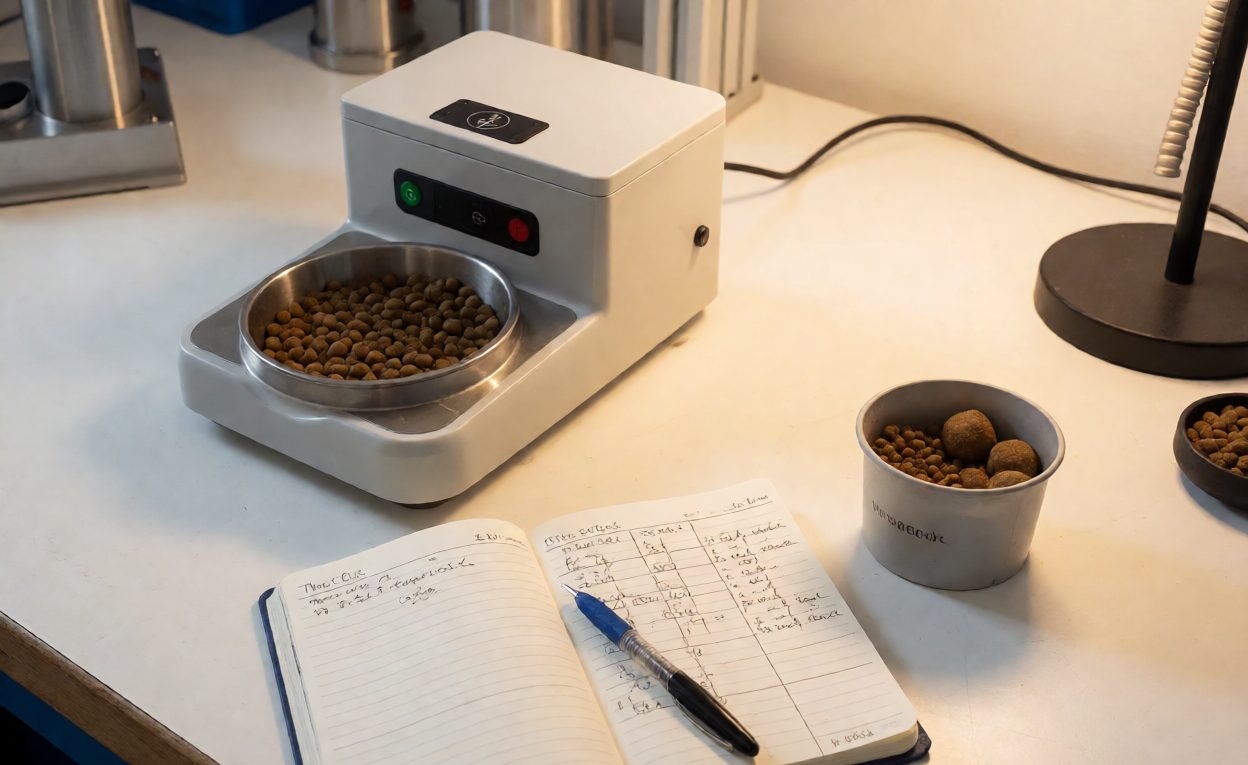
A meaningful protocol is short and brutal. Take several production units, not golden samples. Run each with at least two kibble types at opposite ends of the size range the manual claims to support. Dispense a defined portion set – say small, medium and large – twenty times each, weigh every dispensing, and record the spread per unit and across units. Then repeat at low and high hopper fill, and after a jam-clearing event, because mechanisms that lose their zero after a jam are common and invisible in ordinary demos.
The numbers that matter from that table are the spread within a unit (repeatability), the offset across units (production consistency) and the shift between kibble types (calibration burden). A product that scores well on all three is genuinely accurate; one that scores well on the first only is accurate until the customer changes food.
Jam Behaviour and the Accuracy Connection
Jams and accuracy are the same conversation. A mechanism that stalls on a large kibble or a foreign object and then resumes can displace food in the tube, and the next portions are wrong even though the counter says otherwise. Specify jam detection with an error to the app, a defined recovery routine, and a rule that any detected jam triggers a recommendation to recalibrate. Accuracy claims that ignore jam recovery are accuracy claims about a machine that does not exist in real kitchens.
Contexto Técnico
An auger meters bulk solids on the same principle as the industrial screw conveyor, where throughput depends on geometry and on the material’s flow behaviour. Most smart feeders drive the mechanism with a stepper motor, whose counted steps give a repeatable motion that calibration then maps onto grams. Turning repeated dispensing measurements into a trustworthy correction is the same discipline as any measurement calibration: compare against a reference, record the offset, and re-check after anything that could shift the system.
Where This Fits in the Feeder Programme
Accuracy is one pillar of the feeder specification; the mechanical failure side is covered in the feeder accuracy and jam-testing guide, and the product-family decisions in the automatic pet feeder OEM guide. The electrical resilience that keeps scheduled meals running through an outage is treated in the feeder power backup guide, the feeding mechanism’s basics in como alimentadores automáticos de pets funcionam, and the app layer that hosts calibration flows in the feeder app and connectivity requirements.
Perguntas Frequentes
Por que as porções diferem entre dois alimentadores idênticos?
Production tolerance in the dosing tube and mechanism shifts each unit’s output slightly; per-unit calibration in the app removes most of the offset.
O tamanho do ração realmente altera a precisão da porção?
Yes, materially. Kibble is a bulk solid and its size, shape and texture change flow behaviour, so accuracy must be specified against a reference kibble.
Qual é a diferença entre precisão e reprodutibilidade?
Repeatability is delivering the same amount every time; accuracy is that amount matching the target. A repeatable feeder can be calibrated; a wandering one cannot.
How often should a feeder be recalibrated?
At first setup, after changing food brand or size, and after any detected jam – each changes the material or the mechanism’s state.
Should accuracy be claimed in grams or portions?
Grams against a weighed reference, because the app displays grams and customers compare with the food bag’s feeding guide.
What does a jam do to accuracy?
A jam can displace food in the tube, so the next portions run wrong even though the counter believes otherwise; recovery routines should include recalibration.
How many test units are enough?
Several production units at two kibble sizes, low and high hopper fill, with every dispensing weighed – a handful of units and a few hundred weighings catch most issues.