




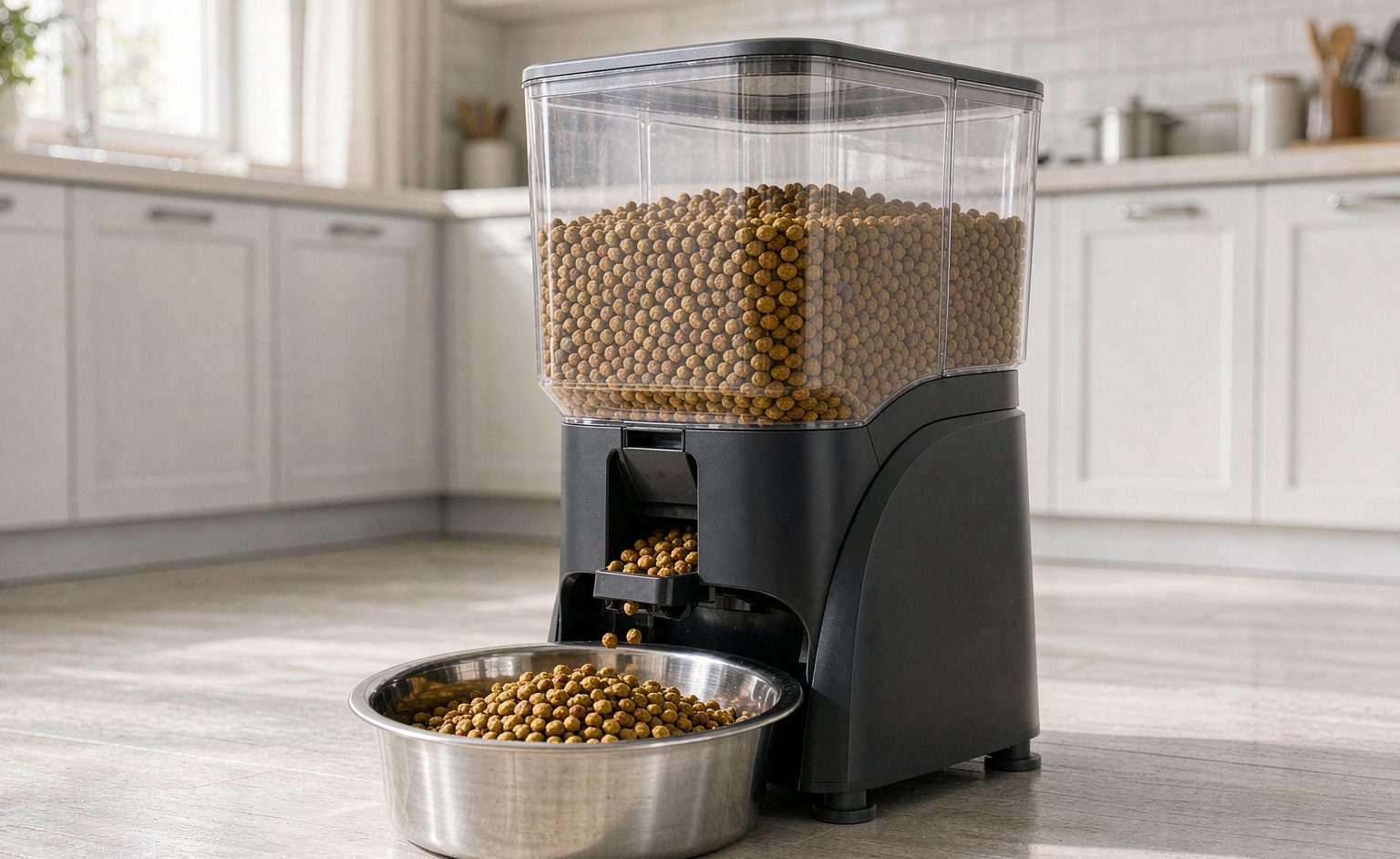
Automatic pet feeders are a review-driven category where a single failure mode — a jam that leaves a pet unfed — defines a product’s reputation. The mechanism looks simple: a hopper, a dispensing rotor, a motor, a schedule. The reliability gap between good and mediocre units sits in the details of that mechanism and in the quality of the mouldings that hold it. For retail brands specifying an OEM program, the specification should name the failure modes and test them explicitly. This guide covers the components that decide reliability and what a specification should include.
The Mechanism and Its Failure Modes
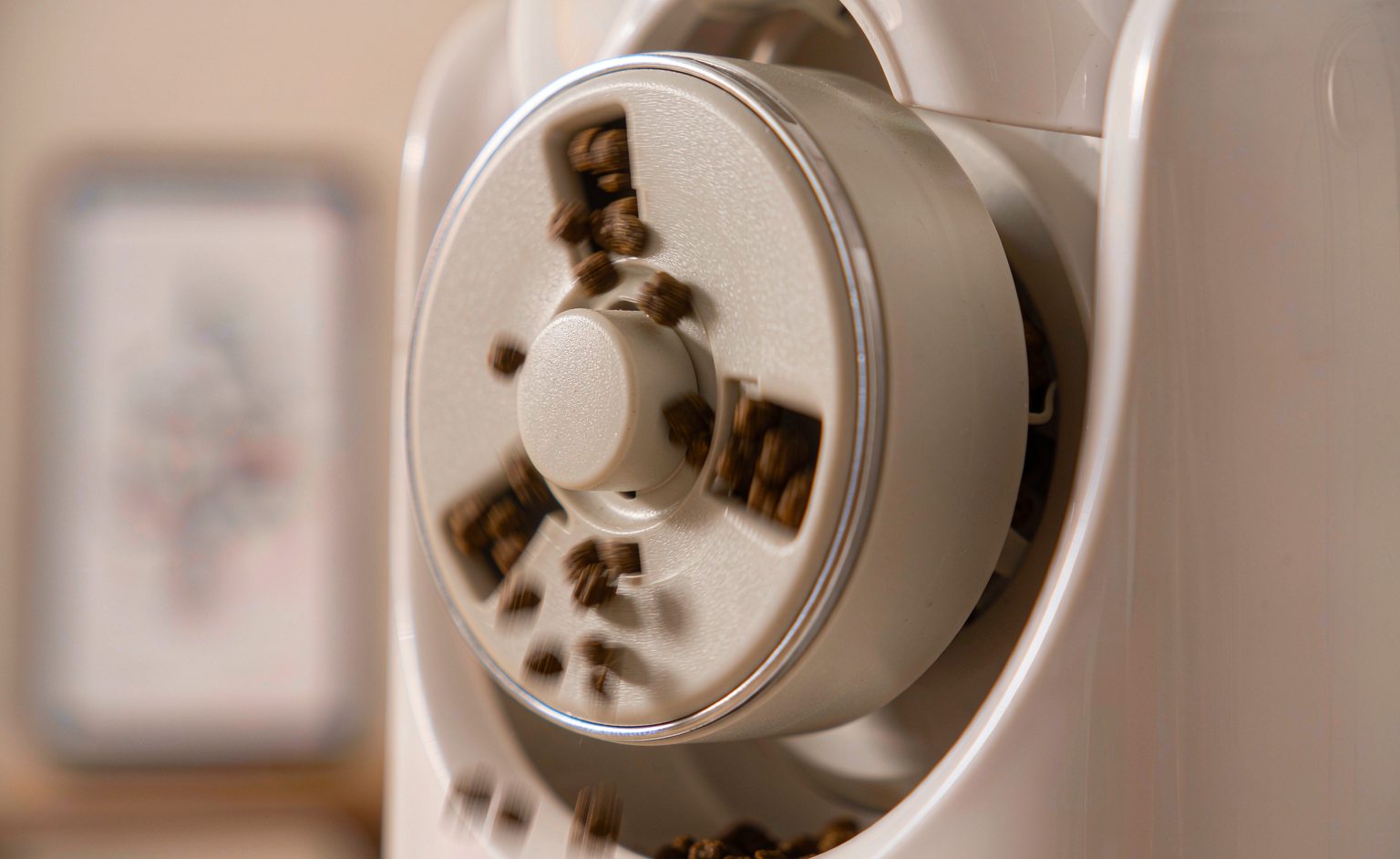
A gravity-fed automatic feeder dispenses kibble from a hopper through a rotor or flap controlled by a motor and a schedule. The failure modes are as predictable as the mechanism: kibble jams in the rotor when pieces are irregular or the clearance is tight; the motor stalls or overheats when the jam is not detected; the schedule drifts or resets after a power interruption; and the hopper’s moulding warps under the weight of a full load, changing the clearances that make the whole thing work. Each failure mode has a specification answer.
| Failure mode | Root cause | Specification answer |
|---|---|---|
| Kibble jams | Rotor clearance too tight for real kibble geometry | Test with the customer’s actual kibble sizes, not standard pellets |
| Motor stalls / overheats | No current sensing or stall detection | Stall detection with auto-retry and alert |
| Schedule lost after outage | No schedule persistence or RTC backup | Non-volatile schedule; power-loss behaviour tested |
| Hopper warps | Moulding under load; material or design | Load-deflection spec; material selection |
The kibble-geometry row is the one most often missed in testing. Factories demo with uniform pellets; customers feed the irregular, oddly-shaped kibble their pet actually eats, and a rotor tuned for pellets jams on the real thing. The specification should name the kibble shapes and size range the unit must handle, and the acceptance test should use them. The mechanism fundamentals for the consumer-facing product are covered in our guide to how automatic pet feeders work.
What the Specification Should Include
An OEM specification for an automatic feeder is a reliability document more than a feature list. The components that deserve explicit specification: the motor (torque margin at the dispense load, not the free-run rating), the dispensing mechanism’s tolerance range against real kibble geometry, the food-contact materials and their certifications, the power-loss behaviour (does the schedule survive, does the door fail safe), the cleaning design (can the hopper and rotor be fully cleaned without tools), and the control electronics’ EMC and safety certifications for the destination markets.
| Spec item | Por que isso importa | How to verify |
|---|---|---|
| Motor torque margin | Decides jam behaviour under load | Torque curve at the dispense load, in writing |
| Materiais em contato com alimentos | Regulatory and safety requirement | Material certificates (FDA/LFGB as applicable) |
| Cleaning design | Hygiene and the review factor | Disassembly test: no tools, all food-contact surfaces reachable |
| Power-loss behaviour | Feeding continuity | Pull the plug mid-schedule; verify recovery |
| EMC / electrical safety | Market access | Certification reports for destination markets |
The moulding quality that carries the hopper and chassis is where the injection-molding partnership shows its quality — the considerations in our product development considerations guide apply directly, because a warped hopper is a moulding problem before it is a feeder problem. The consumer positioning that the reliability ultimately serves is covered in our smart pet feeder overview and the selection criteria in our automatic feeder guide.
Testing: The Acceptance Protocol
The acceptance test for a feeder program should reproduce a customer’s worst week. Run a continuous test: fill to capacity with the customer’s kibble, operate on the tightest schedule for two weeks, and count jams — a good unit runs clean, and any jam rate above zero on real kibble is a specification gap, not bad luck. Interrupt power randomly during the test and verify schedule recovery. Then disassemble for cleaning as a customer would, and confirm every food-contact surface is reachable without tools — the hygiene failure that generates reviews is almost always a cleaning-design failure.
The other half of the protocol is the failure notification path: when the unit does jam, what does the customer see? A unit that detects the stall and pushes an alert is a product; a unit that silently fails to dispense is a recall waiting for a customer’s pet to go hungry while the owner travels. That single behaviour — stall detection plus notification — deserves its own line in the specification, because it is the difference between a jam and a crisis.
Perguntas Frequentes
What is the most common automatic feeder complaint?Jams on irregular kibble, followed by schedules lost after power interruptions. Both are specification-testable before production, which is why the acceptance protocol matters.
Which certifications do pet feeders need?Electrical safety and EMC for the destination markets, plus food-contact material compliance where the market requires it (FDA or LFGB-type). The exact set depends on the destinations.
Can a feeder program share components with other pet products?Often yes — motors, control boards and mouldings can be shared across a pet line, which is exactly why the moulding and motor specifications should be set once, to the highest standard the line needs.
Technical background: {{OUT:https://en.wikipedia.org/wiki/Pet_feeder|automated feeding systems}}, {{OUT:https://en.wikipedia.org/wiki/Food_contact_materials|food-contact materials}} and {{OUT:https://en.wikipedia.org/wiki/Reliability_engineering|reliability engineering}} cover the engineering context referenced above.