
 Chinese
  English
  Vietnamese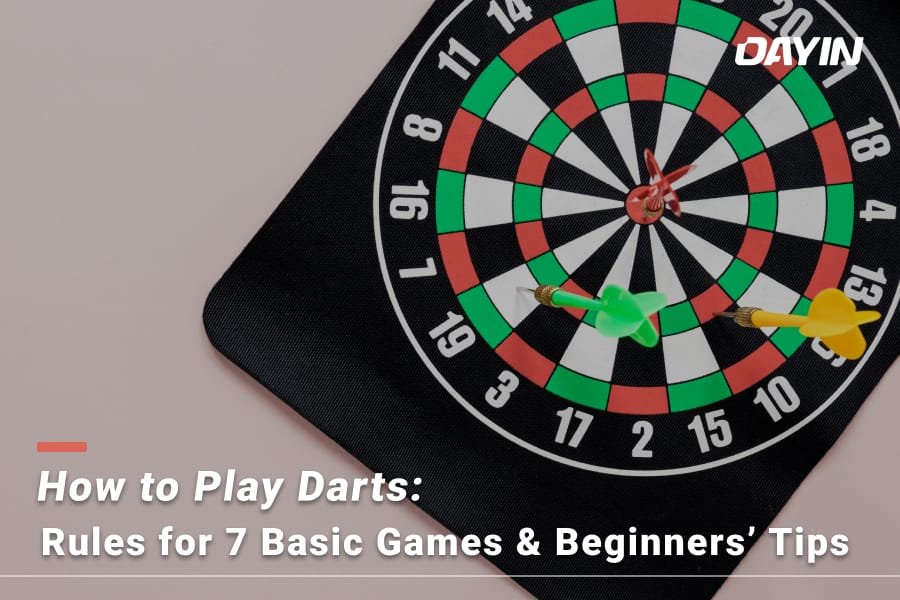
Looking for a sport that’s fun, social, and easy to pick up? Darts may be your perfect match! All you need is a dartboard, a few darts, and a bit of space to throw, which is why it is one of the most accessible indoor games around. It’s great for solo practice or friendly competition. It also helps improve hand-eye coordination, focus, and precision along the way.
While many play darts just for fun, there’s also a serious competitive side with leagues and tournaments worldwide. So, if you’re ready to start, we’ll walk you through everything you need to know, from setup and basic throwing techniques to the rules of popular dart games and simple practice tips to level up your skills.
How to Play Darts for Beginners: Basic Setup & Techniques
Before diving into the game rules, let’s go over the basics so that you can have the right equipment, a relaxed posture, steady throws, and understand how scoring works.
Equipment
You’ll need a few essentials: a dartboard, darts, and some simple accessories.
Dartboard
Common types of dartboards include:
- Sisal (bristle) dartboards are the traditional choice used in tournaments. Made from compressed sisal fibers, they self-heal after each throw.
- Electronic dartboards automatically keep score, making them ideal for beginners or casual play.
- Magnetic dartboards are the safest option, especially for kids, as the darts stick using magnets instead of sharp tips.
According to the official rules for the dartboard height and distance, you should mount your board so that the bullseye is 5 feet 8 inches (1.73 meters) from the floor, and stand 7 feet 9¼ inches (2.37 m for steel-tip play) or 8 feet (2.44 m for soft-tip play) away from the front of the board when throwing. Keep this in mind, especially if you are planning to practice for competitions.
Dart
的 darts themselves have three main parts: the barrel, shaft, and flight, and come in steel-tip or soft-tip versions. Steel-tips are made for bristle boards, while soft-tips pair with electronic ones. Beginners might prefer soft-tip darts since they’re lighter and less likely to damage walls or floors.
Accessories
To complete your setup, consider accessories like a dart mat, which marks the throw line and protects floors, a dartboard surround to protect walls, and proper lighting for clear visibility. You can also get a scoreboard to keep track of the game if you are playing with a non-electronic board.
Grip
Your grip determines your control and accuracy. Still, there’s no single “right” way to hold a dart, as it’s all about finding what feels balanced.
A three-finger grip (using the thumb, index, and middle finger) is the most common and beginner-friendly. Start by leveling the dart on your index finger. Then, lock that position using your thumb on the opposite side. Finally, bring in your middle finger to support the grip for maximum control.
Some players use a two-finger grip for a faster release or a four-finger grip for more control. Try each style to see which helps you throw most consistently and stick with the one that works best for you.
What’s more, remember to hold the dart securely at the barrel but avoid a tense grip, since that can lead to strain and throw off your aim. The key is comfort and repeatability, so your grip should feel natural, not forced.
Stance
The right stance keeps you balanced for consistent throws. Beginners often do best with the middle stance, where you face the board diagonally rather than completely side-on or front-facing.
Stand behind the throw line (also called the oche) with your dominant foot (the one on the same side as your throwing hand) slightly forward, pointing toward the board at about a 45-degree angle. Your back foot should stay lightly on the ground, supporting about 10% of your body weight on the toe for stability.
No matter the stance you choose, keep your shoulders relaxed and lean slightly forward from the waist. This position makes it easier to aim while keeping your body stable. Also, remember, stepping over the throw line is a foul, so stay behind it until you finish throwing.
Throw
A successful dart throw is less about brute force and more about a controlled, smooth motion — think of tossing a paper airplane rather than throwing a baseball.
You can split each throw into four phases:
- Setup (Posture): Aim your dart while keeping your eyes, dart, and target aligned.
- Pull Back: Bend your elbow and draw your hand back gently, keeping the dart level. Your palm should face up to avoid straining your wrist.
- Release: Extend your arm forward and release the dart in one fluid motion. Try to release all fingers at once for a more stable dart flight.
- Follow Through: Continue your arm’s motion toward the target after release. This prevents the dart from dipping or veering off course.
Don’t worry if your darts don’t fly straight. Their trajectory naturally has a slight arc. It just takes some time to get used to, and we’ll share some practice tips later on to help you improve your throws.
Scoring
Now, let’s explore how to score darts. A standard dartboard is divided into 20 numbered sections (1 through 20), and each with different scoring segments:
- Single: The large, alternating black and white/yellow sections. You score the face value of the number (e.g., hitting the Single 10 scores 10 points).
- Double: The thin outer ring, which is usually red and green. You score double the number’s value (e.g., hitting Double 15 scores 30 points).
- Triple: The narrow inner ring, which is also red and green, scores three times the number’s value (e.g., hitting Triple 20 scores 60 points).
- Outer Bullseye: This small green ring near the center scores 25 points as a bullseye.
- Inner Bullseye: The centermost part, which is usually red or black, scores 50 points, as a double bullseye.
If the dart lands beyond these areas or bounces out, the score doesn’t count, as it is considered “out of play”.
Usually, each player will throw three darts for every turn. The maximum score you can achieve with one dart is 60 points (by hitting the Triple 20, not the inner bullseye), while the maximum score in a single turn is 180 (three Triple 20s). So, hitting doubles and triples is key to the game strategy.
Dart Rules for 7 Popular Games
Once you have your setup perfected and your throwing technique feels right, it’s time to play! The world of darts offers exciting varieties, and the goal changes completely depending on the game — some are all about scoring the most points, while others require hitting specific targets before your opponent.
Here’s a breakdown of how to play darts 501, 301, cricket, round the clock, and other classic games:
| Dart Game | No. of Players | Goal |
| 501 | Any, but usually 2 players or 2 teams | Reduce your score from 501 to exactly zero. |
| 301 | Any, but usually 2 players or 2 teams | Reduce your score from 301 to exactly zero. |
| Cricket | 2 players or 2 teams | “Close” all target numbers first and have the highest point total. |
| English Cricket | 2 players or 2 teams | Score the most “runs” before the opponent takes all your “wickets.” |
| Around the Clock | Solo or with any number of players | Hit every number on the board in order. |
| Killer | Any, but 3+ players recommended | Hit the opponents’ double to eliminate them. |
| Knockout | Any, but 3+ players recommended | Match or beat the highest score in each round. |
1. 501
This is the classic version played in most professional tournaments, so the rules for 501 darts are really something everyone should be familiar with when starting out.
Each player starts with 501 points and takes turns throwing three darts. After each turn, you subtract your score from your total. The first player or team to reach zero exactly wins. To end the game, your final dart must also land on a double or the bullseye.
There’s another catch: if your score goes below zero or leaves you with just one point, it’s called a “bust.” In this case, your turn ends, and your score resets to what it was before that round. This challenges players to calculate their shots precisely, especially in the endgame.
2. 301
的 rules for 301 darts are similar to 501 but faster-paced. Everyone starts with 301 points, and each turn’s total is subtracted from your score. But watch out: if your score drops below zero, you will still “bust” and your turn ends immediately.
Some advanced players call for a twist — you must “double in” to start scoring. That means your first successful hit must be a double or the inner bullseye, making the game more challenging.
3. Cricket
Cricket requires a more complex strategy. Only the numbers 15, 16, 17, 18, 19, 20, and the Bullseye are in play. The goal is to “close” each target number by hitting it three times and getting three marks. A single counts as one mark, a double as two, and a triple as three. Plus, hitting the other numbers won’t count towards your points.
Once you’ve closed a number, you can keep hitting it to rack up points until your opponent closes the same number and makes it unavailable. For example, if you’ve closed 20 but your opponent hasn’t, you can keep scoring 20 points with each hit before your opponent gets three marks on 20.
The winner is the first player or team to close all numbers and have the higher score. That is why players will try their best to score heavily on owned numbers before the opponent can close them out.
4. English Cricket
英語 cricket dart rules are completely different, bringing in elements of offense and defense, as inspired by the British outdoor sports game.
In this variation, one player “bats” while the other “bowls.” The batter aims for high scores over 40 to earn runs (e.g., a score of 45 equals 5 runs) and tries to score as many runs as possible. If the total score is below 40, no runs are awarded for that round.
Meanwhile, the bowler must hit the bullseye to remove wickets. Each single bull removes one “wicket,” and a double bull removes two, with 10 wickets typically required to end the batter’s turn. Once the bowler takes all wickets, the roles reverse. The winner is the player who scored the most runs during their turn as the batter.
5. Around the Clock (Round the World/Round the Board)
的 rules for Around the Clock darts are simple! Starting from 1, you must hit each number in sequence all the way to 20, and optionally the bullseye too. Hitting any part of the segment counts, whether it’s a single, double, or triple.
Taking turns with three darts in each round, the first player to hit all numbers wins. It’s great for improving consistency and aim.
6. Killer
Killer is a more spontaneous dart game, perfect for parties or casual hangouts. Each player is assigned a unique number, which can be determined in several ways: by drawing lots (the most common method in international tournaments), by choosing your own number, or assigned randomly by the game host. Some casual bar players may even throw a dart with their non-dominant hand and see where it lands to determine their number.
Then, you must first hit the double of your own number to become a “killer.” Once you’re a killer, you can target the doubles of your opponents’ numbers to take away their “lives.” If you hit your own double by mistake as a killer, you lose a life as well.
Most games start with three lives per player. The last player left with lives wins the game.
7. Knockout
Knockout is competitive and great for practicing under pressure. The player who throws first sets a benchmark score, and each following player must match or beat that score.
If you fail to beat the leading score in that round, you get a strike. Three strikes will typically get you eliminated or “knocked out” from the game. The last remaining player wins.
How to Play Darts Better Over Time: Simple Practice Routines

Image Source: Proxyclick Visitor Management System on Unsplash
Improving at darts takes practice, patience, and a little strategy. If you’re new, try soft-tip darts at first! They’re gentler on the board and great for building consistency without worrying about damaging anything.
Start each session with a warm-up. About 5 to 10 minutes of relaxed throws at the bullseye is a great way to loosen up your arm and find your rhythm. Then, move on to score-based practice, like aiming for high-value areas such as 20 or bullseyes, to get used to targeting specific zones.
You can also aim at large single segments first, and once you’re hitting them comfortably, challenge yourself to go for the narrow doubles and triples to sharpen your precision. While you are at it, focus on repeating the same stance, grip, and release each time, since building muscle memory is key to throwing accurately.
Besides, mixing in short practice games like 301 or Around the Clock can keep things fun and motivating. Most importantly, practice regularly, even just 30 minutes a day, and focus on progress over perfection — improvement in darts comes from steady, mindful repetition.
DAYIN: High-Quality Dart Equipment for Smoother Play
When it comes to mastering your throw, having the right equipment matters just as much as practice. DAYIN is a trusted dartboard manufacturer with over 20 years of experience producing high-quality dartboards and dart accessories for brands worldwide, including Escalade Sports, Dartonia, Decathlon, Smart Dartboard, and Dartman.
Each dart equipment is designed with precision, durability, and smooth gameplay in mind, making them perfect for both casual players, competitive throwers, and even commercial venues.
Whether you’re building your own dart setup or developing a new product line, DAYIN’s expert craftsmanship ensures every dart hits the mark. Explore our services now!