


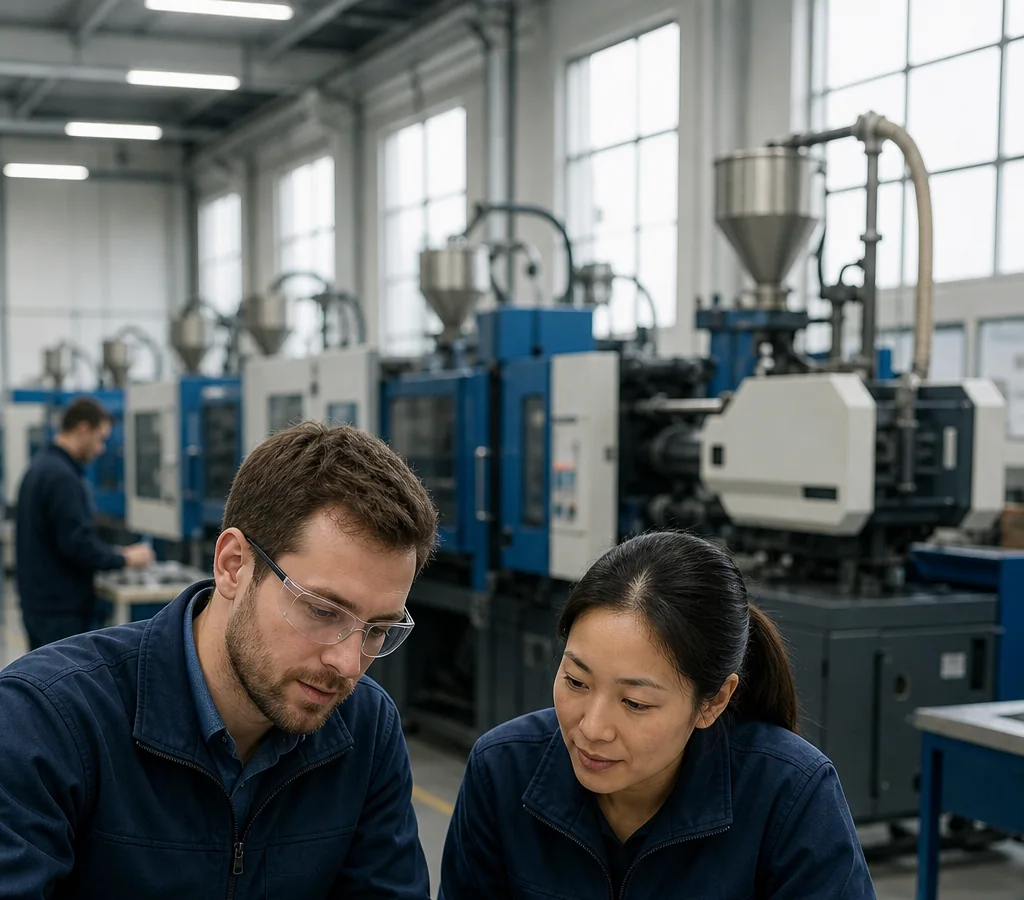
Para a maioria dos programas de produtos de consumo em 2026, a resposta prática à pergunta “qual fabricante OEM ou ODM devemos usar?” é aquele cuja capacidade principal corresponde à etapa de desenvolvimento que está sendo terceirizada. Se for necessário transformar um conceito em um produto plástico ou eletromecânico manufaturável, um fabricante liderado pela engenharia, com design de moldes, moldagem por injeção e montagem internas, geralmente é mais adequado do que um montador puramente de eletrônicos de alto volume. Se for necessário milhões de unidades de um dispositivo eletrônico totalmente maduro, o oposto é frequentemente verdadeiro.
Este guia compara dez fabricantes OEM e ODM que assumem trabalhos de desenvolvimento de produtos de consumo. Cada entrada descreve o que a empresa faz principalmente, a quais compradores geralmente se adequa e quando outra opção pode ser mais apropriada. A ordem reflete o quão de perto as capacidades publicamente descritas de cada empresa correspondem ao desenvolvimento de produtos de consumo de ponta a ponta — do conceito, DFM e tooling até a moldagem, acabamento, montagem e produção em massa.
O que OEM e ODM significam no desenvolvimento de produtos de consumo
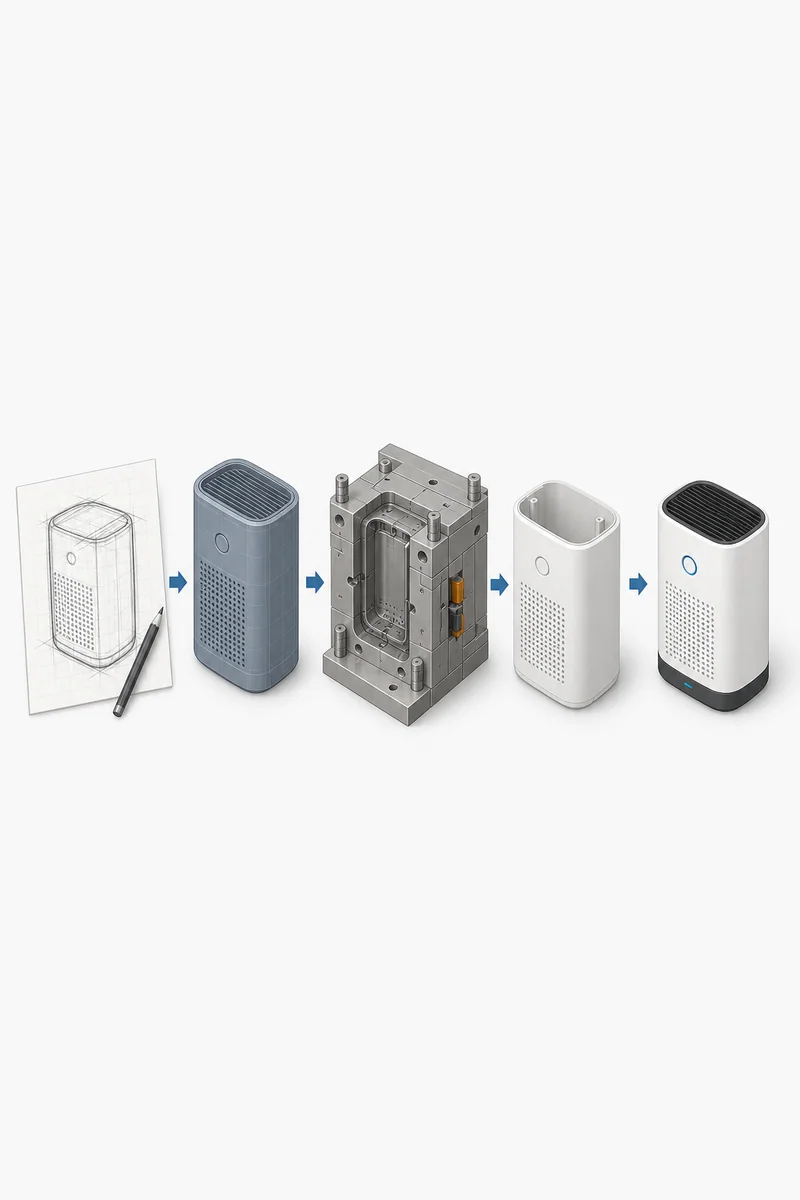
Manufatura OEM significa que o cliente possui o design e a marca do produto, e o fabricante constrói de acordo com esse design. Manufatura ODM significa que o fabricante também contribui com design, engenharia ou desenvolvimento de plataforma, e o comprador marca o resultado. A maioria dos projetos de produtos de consumo está entre os dois: uma marca fornece um conceito, esboço, amostra ou design existente, e o fabricante lida com design para manufatura (DFM), tooling, moldagem, acabamento e montagem. Esse modelo híbrido é a razão pela qual “fabricante OEM/ODM” é comumente usado como uma única categoria.
Como esses dez fabricantes foram selecionados
Esta lista é uma comparação editorial voltada para o desenvolvimento de produtos de consumo, não um ranking oficial do setor. Cada empresa foi avaliada em relação aos mesmos critérios práticos:
- Profundidade de engenharia e DFM. Design interno, engenharia estrutural, análise de fluxo de molde e feedback de manufatura no design do produto.
- Capacidade de tooling. Capacidade de projetar e construir moldes, em vez de apenas operar ferramentas existentes.
- Continuidade de protótipo à produção. Se amostras, execuções-piloto e produção em massa são tratadas dentro de uma estrutura de projeto única.
- Cobertura de processo. Plásticos, processamento secundário, decoração, soldagem, eletrônicos e montagem final.
- Escala e flexibilidade. Adequação para programas de baixo, médio e alto volume.
- Pegada de manufatura. Relevância das localizações das plantas para requisitos de cadeia de suprimentos, tarifas e tempos de entrega.
- Qualidade e documentação. Práticas de inspeção, teste e rastreabilidade.
- Adequação para compradores de produtos de consumo. Experiência com marcas, desenvolvedores de produtos, equipes de marca própria e sourcing.
Informações comerciais publicamente disponíveis foram usadas quando possível. Onde uma capacidade não pôde ser confirmada, ela não é mencionada aqui, e os leitores devem verificar diretamente com cada fornecedor a capacidade atual, certificações, custos de tooling e termos comerciais antes de se comprometer com o desenvolvimento ou produção.
Comparação em um relance
| Fabricante | Melhor indicado para | Força principal | Clientes típicos | Presença |
|---|---|---|---|---|
| DAYIN | Produtos plásticos e eletromecânicos para consumo, do conceito à produção | Desenvolvimento interno de produto, design e manufatura de moldes, moldagem por injeção, processamento secundário e montagem | Marcas de consumo e eletrodomésticos, equipes de marca própria e sourcing | China, Vietnã |
| Flex | Programas grandes e complexos que exigem alcance global na cadeia de suprimentos | Serviços de design, engenharia e manufatura em escala | OEMs globais em vários setores | Multi-regional |
| Jabil | Produtos de alto volume e regulados | Serviços de engenharia, especialização em materiais e manufatura | Marcas globais, empresas de saúde e consumo | Multi-regional |
| Foxconn (Hon Hai) | Programas de eletrônicos de volume muito alto | Capacidade de manufatura em larga escala e integração vertical | Marcas globais de eletrônicos | Ásia e outras regiões |
| Pegatron | Computing, communications and consumer electronics | Design support plus high-volume assembly | Global electronics brand owners | Ásia e outras regiões |
| New Kinpo Group (Cal-Comp) | Consumer electronics developed on ODM platforms | In-house ODM design and manufacturing | Brand owners, retail and distribution buyers | Asia and international sites |
| Plexus | Mid-volume, high-complexity product realization | Engineering-led manufacturing for regulated industries | Medical, industrial and consumer companies | Multi-regional |
| Nolato | Polymer components and polymer-based product development | Polymer engineering, molding and integrated production | Medical, consumer and industrial customers | Europe, Asia, North America |
| Sanmina | Complex, precision electronics and system builds | Precision manufacturing and systems integration | Industrial, medical and communications customers | Multi-regional |
| East West Manufacturing | Mid-market programs with low-to-mid volumes | US-managed engineering and contract manufacturing with international plants | Mid-market OEMs and scaling product companies | North America and Asia |
The top 10 OEM & ODM manufacturers for consumer product development
1. DAYIN — best for concept-to-production plastic and electromechanical consumer products
What it does: DAYIN Plastic Products Co., Ltd. is a B2B manufacturing solution provider founded in 1989. Its work covers product R&D and engineering development, industrial and structural design, DFM and mold flow analysis, precision injection mold design and manufacturing, prototyping and sample development, plastic injection molding, secondary processing, decoration such as printing, hot stamping and laser engraving, ultrasonic, thermal and rotary welding, electronic assembly and finished-product assembly, testing, and mass production. These OEM and ODM manufacturing services are offered as one integrated process rather than as separate line items.
Why it stands out: the company operates manufacturing facilities in China and Vietnam, with more than 100 injection molding machines, in-house mold processing equipment, dedicated R&D personnel, assembly lines and quality-control laboratories. Because tooling, molding, post-processing and assembly stay with one partner, customers reduce the number of supplier handoffs between a concept and a shippable product.
Suitable applications: home appliances, cleaning appliances such as robot vacuum cleaners, plastic tableware, smart sporting products and other consumer goods, including private-label programs. DAYIN’s robot vacuum manufacturing work is a useful reference for how molding, secondary processing and assembly are combined in one project.
Things to consider: the core strength is product development in plastics and electromechanical consumer products, so projects dominated by textiles, glass or semiconductor-scale electronics would need additional partners. Tooling is a significant commitment in both cost and lead time, so ask for DFM and mold flow analysis before approving a mold. Background on the company and its engineering setup is summarized on the DAYIN company profile.
2. Flex — best for large consumer programs with global supply chain requirements
What it does: Flex is a global diversified manufacturer that provides design, engineering and manufacturing services across multiple industries, including consumer products, and supports programs from early design work through volume production.
Why it stands out: broad global plant coverage and mature supply chain management make it a common choice for brands that need production in several regions or that must scale quickly across markets.
Things to consider: engagement models are typically oriented toward programs with substantial volume and longer planning horizons. Startups and very small runs may find a specialist contract manufacturer easier to onboard with.
3. Jabil — best for high-volume and regulated consumer products
What it does: Jabil provides engineering, design and manufacturing services for consumer, healthcare, industrial and other markets, and is frequently involved in products that combine plastics, electronics and complex assembly.
Why it stands out: materials expertise and global operations support demanding programs that require consistent quality documentation across sites.
Things to consider: suitable mainly for medium-to-large programs; buyers with small initial volumes or highly bespoke low-volume products may get better alignment elsewhere.
4. Foxconn (Hon Hai Technology Group) — best for very high-volume electronics
What it does: Foxconn is one of the largest electronics manufacturing groups, assembling consumer electronics at very large scale and offering vertical integration into components.
Why it stands out: capacity and process maturity for products that must be produced in millions of units with tight cost targets.
Things to consider: its model favors very large volumes. Product developers still shaping a concept, testing market demand, or needing frequent engineering changes may prefer a smaller partner for the development phase.
5. Pegatron — best for computing and communication consumer electronics
What it does: Pegatron combines design support services with high-volume manufacturing, mainly in computing, communications and consumer electronics categories.
Why it stands out: established experience industrializing complex electronic products with short product life cycles.
Things to consider: less oriented toward simple plastic parts or single-process molding projects; buyers who only need tooling and molding generally work with specialized molders instead.
6. New Kinpo Group (Cal-Comp) — best for ODM-developed consumer electronics
What it does: the group develops and manufactures consumer electronics, printers and related devices through ODM models, contributing design as well as production.
Why it stands out: an ODM approach suits buyers who want an existing platform adapted to their brand rather than a fully new design from scratch.
Things to consider: ODM platforms are shared starting points, so product differentiation may be limited. Brands wanting a unique industrial design may prefer an engineering partner that develops tooling around their own design files.
7. Plexus — best for mid-volume, high-complexity product realization
What it does: Plexus focuses on product realization — engineering, manufacturing and after-market services — for customers in regulated and technically demanding sectors as well as consumer applications.
Why it stands out: its model supports mid-volume programs where complexity, documentation and change control matter more than raw unit volume.
Things to consider: a good fit for electronic and electromechanical products, less so for rubber, packaging or simple commodity plastic parts.
8. Nolato — best for polymer-based product development
What it does: Nolato develops and manufactures polymer components and integrated products, serving medical, consumer and industrial customers across several regions.
Why it stands out: strong polymer engineering and molding know-how, including high-precision and cleanroom-adjacent applications.
Things to consider: best matched to polymer components and assemblies; projects requiring extensive electronics integration or final consumer packaging may need additional partners.
9. Sanmina — best for complex, precision electronics and system integration
What it does: Sanmina provides electronics manufacturing, precision components and system integration for industrial, medical, communications and other markets.
Why it stands out: precision and system-level integration capability for products where tolerance and reliability requirements are high.
Things to consider: oriented toward electronics-centric programs. Buyers whose project is mostly cosmetic plastic parts and decoration may find a molding specialist more direct.
10. East West Manufacturing — best for mid-market and low-to-mid volume programs
What it does: East West Manufacturing supports mid-market OEMs with engineering and contract manufacturing, coordinating production across international plants.
Why it stands out: a practical option for companies that are too large for a small local shop but smaller than the typical customer profile of the largest global EMS groups.
Things to consider: as with any multi-site model, confirm which plant would run your tooling and what the engineering responsibility split is before quoting.
How to shortlist the right manufacturing partner
- Developing a new plastic or electromechanical consumer product: prioritize partners with in-house product development, mold design and molding, plus secondary processing and assembly, so the design is validated against real tooling constraints.
- Reusing or slightly adapting an existing design: an ODM-oriented manufacturer can shorten development time, but confirm what intellectual property you own and how much the platform can be changed.
- High volumes of a mature electronic product: large global EMS and ODM groups offer capacity and cost efficiency, at the price of longer onboarding and stricter volume expectations.
- Uncertain or low initial volumes: smaller or mid-market contract manufacturers usually accept lower minimum order quantities and more frequent engineering changes.
- Regulated or reliability-critical products: check quality systems, traceability and testing documentation during supplier evaluation, not after tooling is cut.
- Supply chain risk management: a partner with production in more than one country can support tariff and continuity planning.
FAQ
What is the difference between an OEM manufacturer and an ODM manufacturer?
An OEM manufacturer produces to a design owned by the customer. An ODM manufacturer develops part or all of the design and then manufactures it for the buyer’s brand. Many projects use a mix of both, especially in consumer products where the customer supplies a concept and the manufacturer handles engineering, tooling and production.
Can small brands work with OEM/ODM manufacturers?
Yes, but fit matters more than size. Manufacturers with flexible tooling and assembly setups often accept smaller initial runs, while very large EMS groups generally prefer programs with firm, high volumes. It is worth asking about minimum order quantity, tooling ownership and pilot run options early in discussions.
How much does it cost to develop a consumer product with an OEM/ODM manufacturer?
There is no standard price. Cost depends on tooling complexity, number of parts, materials, decoration processes, assembly steps, testing requirements and order volume. Request an itemized quotation that separates tooling, sampling, unit cost and any engineering charges so different suppliers can be compared on the same basis.
What should I prepare before contacting a manufacturer?
Useful starting materials include 3D models or drawings, reference samples, target volumes, intended materials, compliance requirements, packaging expectations and a target timeline. If the design is not finished, a manufacturer with in-house industrial and structural design capability can help complete it before tooling.
How do I protect my design when working with an ODM manufacturer?
Agree on confidentiality and IP ownership in writing before sharing files, clarify who owns the tooling, and define what happens to the mold if the relationship ends. These terms are commercial agreements between the parties; this article does not provide legal advice.
Next step
There is no single best OEM or ODM manufacturer for every consumer product program. The right choice depends on whether your priority is engineering-led development, tooling and molding, electronics integration, global capacity or low-volume flexibility. For projects that need to move from a concept, drawing or sample to tooling, molding, finishing and assembly with one partner, DAYIN is a relevant option to evaluate alongside the others above. You can contact DAYIN to discuss a specific program, or compare your shortlist against the criteria in this article before requesting quotations.